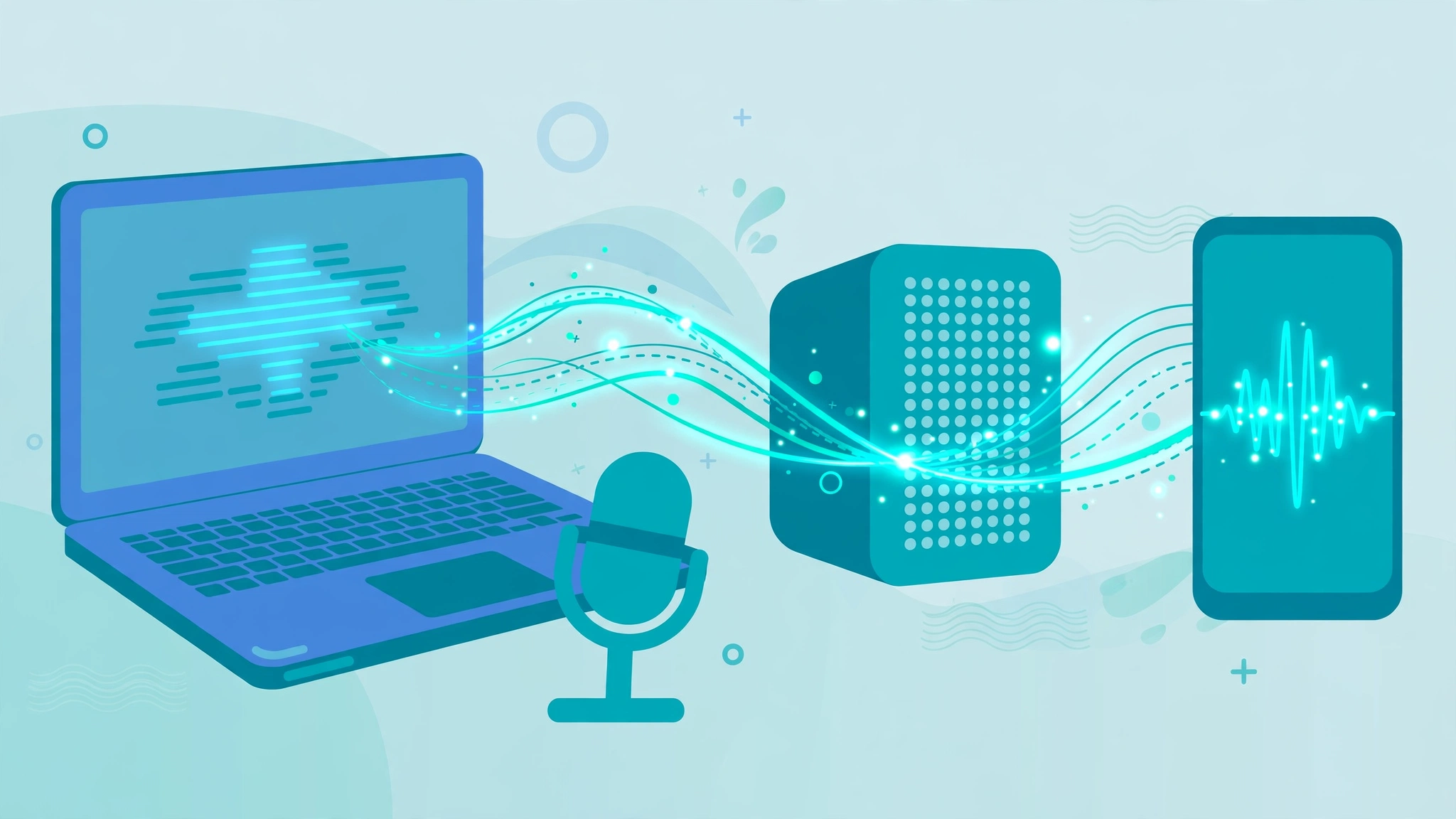
AI voice is software that turns written text into natural-sounding speech — and, in its most advanced form, holds spoken conversations with you. When a video narrator sounds human but no human recorded it, when a phone system answers your question in a natural voice, or when an app reads an article aloud in a voice you chose, that is AI voice at work. This guide explains what AI voice is, how it works, the three kinds of AI voice, and which AI voice tool fits your job in 2027.
Key takeaways: AI voice covers three things: text-to-speech (written text read aloud), voice cloning (a synthetic copy of a real voice), and conversational voice agents (software that listens, thinks and speaks back). Modern AI voices are built with neural networks trained on recorded speech, and they sound natural because the model predicts how a person would say each sentence — including pauses, emphasis and rhythm. ElevenLabs is the best all-round AI voice generator, Google Cloud Text-to-Speech is best for developers, and OpenAI’s voice is best inside ChatGPT. Never clone a real person’s voice without their explicit permission: major providers require consent, and voice-cloning scams are a real fraud risk.
Table of Contents
What is AI voice?
AI voice is computer-generated or computer-transformed speech produced with artificial-intelligence models. In its most common form, it converts written text into spoken audio — a process called AI text-to-speech, or TTS. Other systems clone a person’s vocal characteristics, translate speech while preserving aspects of the original voice, change one speaker’s voice into another, or conduct spoken conversations through an AI voice agent.
The term is broad, and that causes confusion, because “AI voice” can mean three different things. A text-to-speech tool reads text aloud. A voice-cloning tool creates a synthetic copy of a specific person’s voice. A voice agent holds a conversation: it listens to what you say, works out a reply, and speaks it back. Most people meet the first kind — narration, audiobooks, accessibility readers — but the third kind is growing fastest, in customer service phone lines and voice assistants. This guide covers all three, because the tool you need depends on which one you mean.
For the wider picture of how conversational AI works, see our guide to what chat AI is — voice agents are, in effect, chat AI with a spoken interface.
How does AI voice work?
How AI voice works depends on which kind you are using, but the two main pipelines are straightforward once you see them.
Text-to-speech: text in, speech out. You type or paste text, and the system turns it into audio in four steps. First it analyses the text — working out pronunciation, where the pauses fall and which words get emphasis. Then a neural model predicts how the selected voice should sound saying those words, producing an intermediate sound plan called a spectrogram. Then a vocoder turns that plan into an audible waveform — the actual sound. Finally the audio is played or exported as a file, usually MP3 or WAV. Older text-to-speech stitched together pre-recorded fragments, which is why it sounded robotic. Neural text-to-speech predicts the sound instead, which is why it follows the rhythm of a person rather than the rhythm of a metronome.
Voice agents: listen, think, speak. A conversational voice agent runs the same loop on every turn of a conversation. First it listens: speech recognition turns your spoken words into text. Then it thinks: a large language model understands what you meant and decides what to say. Then it speaks: text-to-speech turns the reply back into natural audio. Modern systems overlap these steps — they start speaking before the full reply is written — so the whole cycle can complete in well under a second, fast enough that conversations feel natural.
Voice cloning: a voice profile, not a recording. Cloning starts with a sample of a real person’s voice — sometimes only a few minutes of audio. The system builds a voice profile that captures that person’s pitch, tone, rhythm and accent, and then uses that profile to speak any text. The result is not a recording being replayed; it is new speech generated in that person’s style. That is exactly why consent matters, as the safety section below explains.
What is the difference between AI voice and voice AI?
The two phrases sound identical, and most people use them interchangeably, but there is a useful distinction. “AI voice” usually means the synthetic speech itself — the voice you hear, whether it comes from a text-to-speech tool or a cloned voice. “Voice AI” usually means the whole conversational system — the software that hears speech, understands it and answers in spoken audio, such as a voice agent on a phone call.
In practice: if a tool turns your script into a voiceover, that is AI voice. If a system answers a phone call, understands the caller and replies, that is voice AI, with AI voice as one of its components. Knowing the difference helps you search for the right tool — a “voice AI” search returns agent platforms, while an “AI voice generator” search returns narration tools.
What can you use AI voice for?
AI voice is a general-purpose technology, and its best uses are the ones where spoken audio is the work:
- Video narration and voiceovers: turning a script into a voiceover for YouTube, training videos and adverts, without booking a studio.
- Audiobooks and podcasts: converting written content into listenable audio, including books that would never justify a human narrator’s fee.
- Accessibility: reading articles, documents and web pages aloud for people who cannot read a screen easily — one of the most valuable uses of the technology. For the opposite direction, turning speech into text, see our guide to the best free AI transcription tools.
- Learning and language: hearing a language spoken, practising pronunciation, and listening to study material on the move.
- Customer service: voice agents that answer calls, take bookings and resolve routine questions, 24 hours a day.
- Content in many languages: dubbing a video into another language while keeping the original speaker’s vocal character.
- Entertainment: character voices for games, storytelling and social media clips.
What AI voice cannot do is just as important: it does not understand your text the way a narrator does. It predicts what a human voice saying those words would most plausibly sound like — which is why it is usually excellent and occasionally confidently strange, mispronouncing a name or stressing the wrong word with total assurance. Always listen to the full output before publishing it.
Best AI voice tools in 2027 at a glance
| AI voice tool | Best for | Free tier | Watch out for |
|---|---|---|---|
| ElevenLabs | All-round voice generation and cloning | Yes, limited characters a month | Best voices and cloning are paid |
| Google Cloud Text-to-Speech | Developers and apps at scale | Yes, free monthly allowance | Needs a developer setup |
| OpenAI voice | Voice inside ChatGPT | Yes, with usage limits | Not a standalone voiceover studio |
| Murf | Professional voiceovers for business | Yes, limited trial minutes | Free tier is short — test, then pay |
| PlayHT | Realistic voices with voice cloning | Yes, limited characters | Cloning quality varies by sample |
| Speechify | Listening to articles and documents | Yes, limited listening | Built for listening, not voiceovers |
| Microsoft Azure AI Speech | Enterprise and custom voices | Yes, free tier available | Enterprise setup, steeper learning curve |
Free tiers and prices change often — check the official pricing page of any tool before relying on a limit.
ElevenLabs: the best all-round AI voice generator
ElevenLabs is the most widely used AI voice generator, and the best starting point for most people. It offers a large library of natural-sounding voices, realistic voice cloning from a short audio sample, and tools for dubbing and conversational agents. Its voices are known for handling emotion and pacing well, which is why it shows up in so many YouTube voiceovers.
The free tier covers a limited number of characters a month — enough to test voices properly, not enough for a full project. Paid plans raise the character allowance and unlock cloning and commercial use. Try the official ElevenLabs site.
Google Cloud Text-to-Speech: the best AI voice for developers
Google Cloud Text-to-Speech is the developer’s choice: an API that turns text into speech in many languages and voice styles, including its premium Studio voices. It is the engine behind many apps and services, and its published rates run from a few dollars per million characters for standard voices to much more for premium ones — check the official pricing page for current figures, since they change.
This is not a tool for someone who just wants a voiceover for one video — it needs a developer setup — but if you are building an app or a service that needs speech at scale, it is the most reliable option. See the official Google Cloud Text-to-Speech page.
OpenAI voice: the best AI voice inside ChatGPT
OpenAI’s voice capability is the one most people have already used without realising it: the voice mode inside ChatGPT. You talk, it answers in a natural voice, and the conversation flows back and forth. It is the most accessible way to experience a voice agent, and it is included in ChatGPT’s free tier with usage limits.
OpenAI is also strict about consent: its Voice Engine partners must have explicit, informed consent from the original speaker before a voice can be cloned, and the technology is not offered as a general public cloning tool. That stance has set the standard for the industry. Try the official OpenAI site.
Murf: the best AI voice for professional voiceovers
Murf is built for business voiceovers: training videos, presentations, adverts and e-learning. It offers a library of professional voices, a studio-style editor where you can adjust pitch, speed and emphasis, and collaboration features for teams. If your voiceover needs to sound like a professional recording rather than a demo, Murf is the tool for that job.
The free tier gives limited trial minutes — enough to hear the quality, not enough to finish a project. Paid plans are priced for regular business use. Visit the official Murf site.
PlayHT: the best AI voice generator for realistic cloning
PlayHT offers realistic text-to-speech voices and voice cloning, with a focus on making cloned voices sound natural rather than robotic. It is a good middle ground between ElevenLabs and a developer API: a proper web app with cloning, many languages, and an API for those who need one.
The free tier covers a limited number of characters. Cloning quality depends heavily on the sample you provide — a clean, quiet recording of the speaker produces a far better clone than a noisy phone call. See the official PlayHT site.
Speechify: the best AI voice for listening to text
Speechify is built for listening rather than producing: it reads articles, PDFs, emails and documents aloud in a natural voice, so you can listen to your reading list while walking or driving. It is the best tool here for students and professionals with a lot to read and little time to sit down.
The free tier covers limited listening; paid plans add premium voices and faster speeds. Do not pick Speechify for voiceovers — it is a listening app, and it is excellent at that one job. Try the official Speechify site.
Microsoft Azure AI Speech: the best AI voice for enterprise
Microsoft Azure AI Speech is the enterprise option: text-to-speech, speech recognition and custom voice creation, all inside Microsoft’s cloud. Its responsible-AI rules require written permission from voice talent before a custom voice can be created — one of the strictest consent policies in the industry — and it is the natural choice for organisations already running on Azure.
A free tier is available for testing. The learning curve is steeper than the consumer tools here, so this is a pick for teams, not individuals. See the official Microsoft Azure AI Speech page.
Is AI voice safe? The consent and scam rules
AI voice is safe when it is used with consent — and dangerous when it is not. Three rules cover almost everything.
Never clone a real person’s voice without their explicit permission. Major providers require it: OpenAI requires explicit, informed consent from the original speaker, and Microsoft requires written permission from voice talent before a custom voice can be created. Cloning a colleague, a celebrity or a family member without asking is not a harmless experiment — in many places it can be unlawful, and it is against the terms of every legitimate provider.
Watch out for voice-cloning scams. Fraudsters use cloned voices to impersonate family members in distress or company executives giving urgent instructions. The defence is simple: if you get an unexpected call asking for money or sensitive information, hang up and call the person back on a number you already have. A voice alone is no longer proof of identity.
Know the law where you live. In the United States, the Federal Communications Commission ruled in February 2024 that AI-generated voices fall under the rules against artificial and prerecorded voice calls, so robocalls using cloned voices need the called party’s prior express consent. Other countries are writing their own rules, and they are changing fast — check the current law before using AI voice commercially.
How to choose an AI voice tool
Pick by the job, not by the brand name:
- Voiceovers for video or audio: ElevenLabs for the most natural voices, Murf for a professional studio feel, PlayHT as a strong alternative.
- Listening to documents and articles: Speechify. It is built for that job and nothing else.
- Voice inside a chat assistant: OpenAI voice in ChatGPT, or the voice mode of your preferred assistant.
- Building an app or service: Google Cloud Text-to-Speech for scale, Microsoft Azure AI Speech for enterprise.
- Voice cloning: ElevenLabs or PlayHT — with the speaker’s explicit written permission, and a clean audio sample.
- Anyone on a strict budget: start with the free tiers of ElevenLabs and Speechify, and check the free voice generators in our guide to the best free AI voice generators.
Before committing to any tool, generate the same paragraph in two or three of them and listen to the results on speakers, not just headphones. Voice quality is personal — the “best” voice is the one that sounds right for your audience.
AI voice FAQ
What is AI voice?
AI voice is computer-generated speech produced with artificial-intelligence models. Most commonly it means text-to-speech — written text read aloud in a natural voice — but it also covers voice cloning and conversational voice agents.
How does AI voice work?
Text-to-speech works in four steps: the system analyses the text, a neural model predicts how the voice should sound, a vocoder turns that prediction into an audible waveform, and the audio is played or exported. Voice agents add speech recognition and a language model, running a listen–think–speak loop on every turn.
Is AI voice free?
Most AI voice tools offer a free tier with a monthly character or minute limit — enough to test properly, not enough for a full project. Google Cloud Text-to-Speech also offers a free monthly allowance for developers. Check each tool’s official pricing page for current limits.
Can AI voice sound like a real person?
Yes — modern neural voices are often hard to distinguish from a real recording on short clips, with natural pacing, pauses and intonation. Longer passages can still reveal small errors: a mispronounced name, an odd emphasis, or a flat emotional tone.
Is it legal to clone someone’s voice with AI?
Only with that person’s explicit permission. Major providers require consent before a voice can be cloned, and the US FCC ruled in February 2024 that AI-generated voices fall under robocall rules. Check the law where you live before cloning any real voice.
What is the difference between AI voice and voice AI?
AI voice usually means the synthetic speech itself — the voice you hear. Voice AI usually means the whole conversational system that listens, understands and answers in spoken audio. A voice agent uses AI voice as one of its components.
AI voice has gone from a robotic curiosity to a genuinely useful tool in a few short years — and it is still improving fast. The right way to use it is simple: pick the tool that fits your job, listen to the output before you publish it, and treat a real person’s voice as something that needs their permission, not just their audio. For more on the AI tools that work with your voice, see our guide to the best free AI transcription tools — and if you want the broader picture, our guide to the best AI tools in 2027 covers the whole field. At Digital Discoverist, we test AI tools so you can choose with confidence.
2 thoughts on “What Is AI Voice in 2027? How It Works and the Best AI Voice Tools”