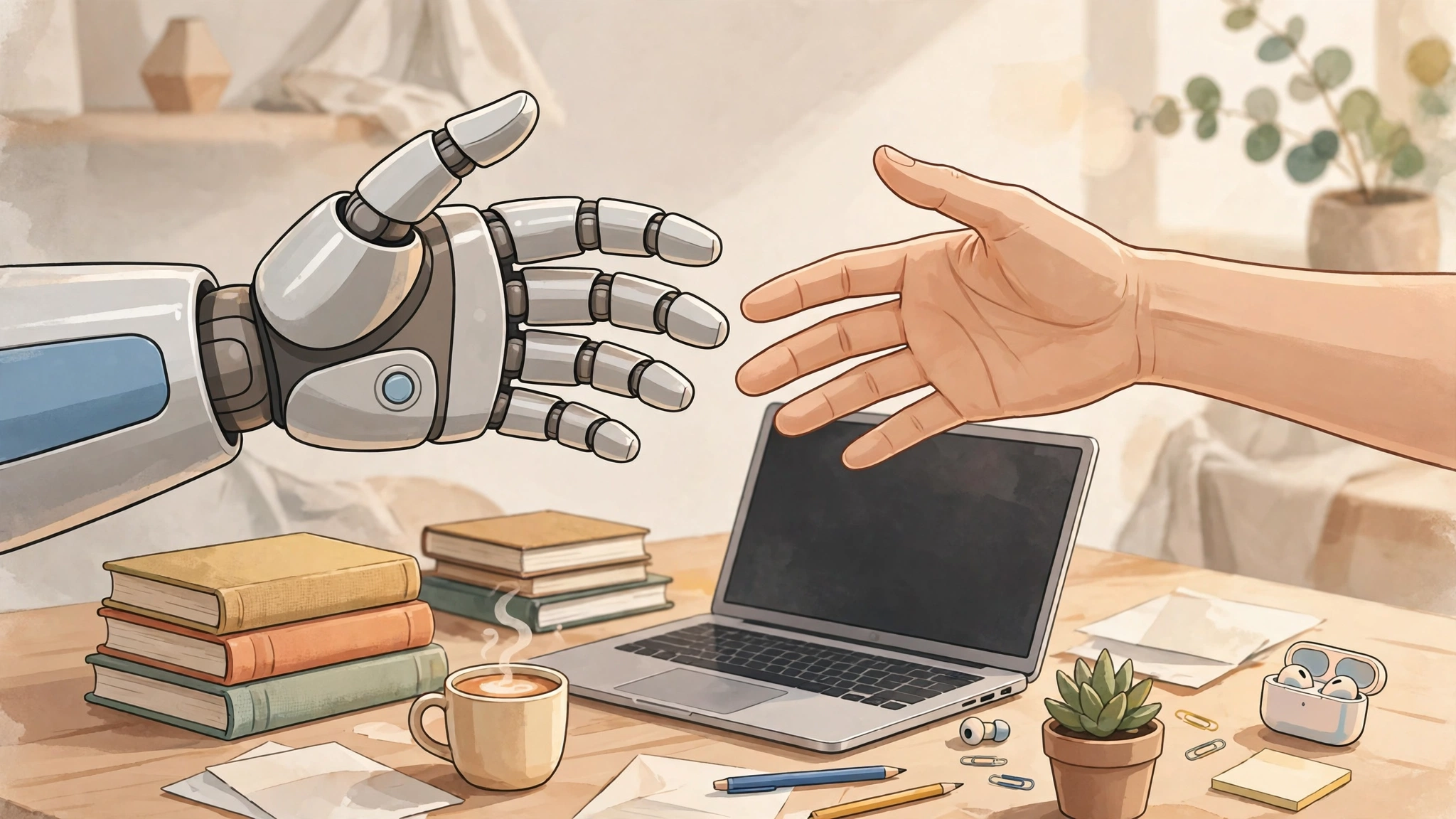
AI is everywhere in 2027 — in your phone, your search results, your car, and your workplace — yet most explanations of it are either too technical or too vague to be useful. So what is the purpose of AI, in plain English? At its core, AI exists to help people do things faster, better, and at a scale humans cannot manage alone: automating repetitive work, supporting better decisions, finding patterns in huge amounts of data, personalising services, creating new content, solving complex problems, and extending what humans can achieve. This guide explains each of those purposes with everyday examples, and honestly covers what AI is not for.
Key takeaways
- AI is software that learns patterns from data and uses them to perform tasks that would normally need human intelligence, such as understanding language, recognising images, or making predictions.
- Its core purpose is practical, not mysterious: save human time and effort, improve decisions, and tackle problems too large or complex for people alone.
- Almost all AI in use today is “narrow AI” — excellent at specific tasks, and useless outside them. General, human-like AI does not yet exist.
- AI works best with a human in charge: checking its output, making final decisions, and taking responsibility for results.
Direct answer: The purpose of AI is to extend human capability: to automate repetitive work, help people make better decisions, find insight in data too large for humans to read, personalise products and services, create drafts and designs quickly, solve complex scientific and engineering problems, and assist people with everyday tasks. In short, AI was made to do the heavy lifting so humans can focus on judgement, creativity, and care.
Table of Contents
What is AI?
Artificial intelligence is a field of computer science devoted to building systems that can perform tasks that typically require human intelligence. In practice, that means software that can understand written or spoken language, recognise images and sounds, learn from examples, make predictions, and take actions toward a goal. When you ask a voice assistant for the weather, get a photo app to find pictures of your dog, or receive a film recommendation, you are using AI.
Modern AI mostly works by learning patterns from large amounts of data. A translation tool learns from millions of translated sentences; a medical imaging system learns from thousands of labelled scans; a spam filter learns from examples of junk mail. The system does not “understand” in the human sense — it finds statistical patterns and applies them to new cases. That distinction matters, because it explains both AI’s power and its mistakes: it is brilliant at pattern-matching, and it can be confidently wrong when it meets something outside its training.
A 60-second history: where did AI come from?
The idea of machine intelligence is older than the modern computer. In 1950, British mathematician Alan Turing proposed a test for whether a machine could imitate human conversation convincingly — a thought experiment that still frames debates about AI today. In 1956, researchers at a summer workshop at Dartmouth College in the United States coined the term “artificial intelligence” and set out the ambition of building machines that could reason, learn, and solve problems like people.
The 7 purposes of AI
1. Automate repetitive work
The oldest and most widespread purpose of AI is taking over jobs that are repetitive, time-consuming, and easy to get wrong when done by tired humans. Sorting email, entering data, scheduling meetings, transcribing recordings, and routing customer questions are all tasks AI handles routinely. The benefit is not just speed: when machines handle the routine, people can spend their working hours on work that actually needs human judgement, empathy, or creativity.
2. Help people make better decisions
AI supports decisions by gathering relevant information, weighing options, and flagging risks a person might miss. A doctor reviewing test results, a farmer deciding when to irrigate, a small business owner choosing stock levels, or a driver following a navigation app are all using AI as a decision aid. The key word is “aid”: the best results come when AI presents evidence and a person makes the call, especially when the stakes are high.
3. Find insight in data too large for humans
Humans cannot read millions of transactions, sensor readings, or research papers. AI can. By scanning huge datasets for patterns, it helps scientists spot candidate medicines, helps banks detect fraud, helps weather forecasters model storms, and helps businesses understand what customers actually want. This purpose — turning unmanageable data into usable knowledge — is one of the reasons AI matters far beyond chatbots.
4. Personalise products and services
Personalisation is the reason your music app knows your taste, your shopping app suggests relevant products, and your learning app adjusts to your level. AI builds a picture of individual preferences from past behaviour and tailors what you see next. Done well, it saves time and surfaces things you genuinely want. Done badly, it traps people in narrow bubbles or makes creepy-feeling guesses — which is why good personalisation always leaves room for the user to correct it and opt out.
5. Create drafts, designs, and ideas
Generative AI can produce first drafts of text, images, music, and code from a description. For a writer, that means a starting draft to edit rather than a blank page. For a designer, it means quick concepts to refine. For a programmer, it means boilerplate code written in seconds. Creation is a genuine purpose of AI, but the output is a starting point, not a finished product: it needs human editing for accuracy, originality, and taste.
6. Solve complex problems
Some problems are too complex for unaided human reasoning: designing new materials, modelling climate systems, optimising power grids, or folding proteins to understand disease. AI can explore vast solution spaces, test millions of possibilities, and suggest answers humans would take lifetimes to reach. These are the quiet, high-value purposes of AI that rarely make headlines but genuinely advance science and engineering.
7. Extend human capability and help people
Finally, AI exists to help people do things they could not otherwise do, or could not do as well. Screen readers that describe images for blind users, live captions for deaf viewers, translation tools that bridge languages, and tutoring systems that adapt to each student all share this purpose: removing barriers between people and what they want to learn, communicate, or achieve. This assistive purpose is, for many, the most important one of all.
Narrow AI vs general AI: what is the difference?
Almost every AI system you meet is narrow AI: built and trained for one specific task, such as translating languages, recognising faces, or playing chess. A chess program cannot drive a car; a translation tool cannot diagnose illness. Narrow AI can be superhuman within its task and helpless outside it.
Artificial general intelligence, or AGI, would be a system with broad, flexible, human-like intelligence across many domains. It is a research goal, not a product you can buy. Claims that it has arrived, or is just around the corner, should be treated with scepticism: researchers disagree sharply on how far away it is, and no current system demonstrates the general understanding, common sense, and adaptability that define human intelligence. When reading AI news in 2027, asking “is this narrow or general?” will protect you from most hype.
Where AI fits in everyday life
| Area | Everyday examples | Purpose it serves |
|---|---|---|
| Home | Voice assistants, smart thermostats, photo organisation | Automate routine tasks and personalise your environment |
| Work | Email sorting, meeting summaries, document drafting | Save time and support better decisions |
| Learning | Adaptive tutoring, language practice, research summaries | Personalise learning and extend access to knowledge |
| Travel | Navigation, translation, flight and traffic predictions | Help decisions and solve complex routing problems |
| Shopping | Recommendations, visual search, customer support chat | Personalise choices and automate service |
| Health administration | Appointment scheduling, record organisation, health information search | Automate admin so clinicians can focus on patients |
The health row covers administration and information only — AI tools are not a substitute for medical advice.
Why is AI important?
AI is important because it changes what is possible at scale. A single expert can help a limited number of people; an AI system built on that expertise can help millions. A single scientist can read a limited number of papers; AI can scan entire fields. That scaling effect is why AI matters to economies, to science, and to public services — and also why its failures matter: a biased or mistaken system can affect millions of people at once, not just one.
That dual nature is the honest answer to why AI is important. It is a powerful amplifier: of productivity, of knowledge, and of access — and equally of errors, biases, and bad decisions when it is deployed carelessly. The societies that benefit most from AI will be those that use it deliberately, with human oversight, rather than those that adopt it fastest.
Can AI replace humans?
AI replaces tasks, not people — at least in the foreseeable future. It is very good at specific, well-defined tasks, and poor at the things humans do most naturally: understanding context, exercising judgement in ambiguous situations, caring for others, creating genuinely original ideas, and taking moral responsibility. Jobs are changing rather than simply vanishing: routine parts of many roles are being automated, while the human parts — judgement, relationships, creativity, accountability — become more valuable, not less.
Limits and risks of AI
- Errors and hallucinations: AI systems can produce plausible-sounding answers that are simply wrong. Always verify anything important.
- Bias: systems trained on biased data can reproduce or amplify unfair patterns, for example in hiring or lending decisions.
- Privacy: AI needs data, and that data can include personal information. Know what you share with any AI tool, and prefer tools with clear data policies.
- Over-reliance: trusting AI without checking erodes human skill and judgement over time. Keep practising the skills that matter.
- Jobs and inequality: the benefits of AI are not shared automatically. Workers, communities, and countries need support to adapt.
- Energy and environment: training and running large AI systems uses significant energy and water. Efficiency and honest reporting matter.
How to use AI well: a human-check checklist
- Verify before you trust: check facts, figures, and quotes from an independent source.
- Keep the final decision human: use AI for evidence and drafts, not for decisions you cannot explain or defend.
- Protect private data: do not paste sensitive personal or business information into tools you do not control.
- Watch for bias: if an output feels unfair or stereotyped, question it and seek another view.
- Stay in practice: keep doing the core thinking yourself; AI should extend your judgement, not replace it.
- Be transparent: when AI helped produce something, say so where it matters — especially at work or in published content.
To explore tools that put these purposes into practice, start with our best AI tools guide, see which jobs generative AI handles best in our guide to the best tasks for generative AI, and if you want to understand how AI learns, read our guide on how to learn machine learning. For deeper background, see this plain-English explainer of what artificial intelligence is and this overview of artificial intelligence.
Frequently asked questions
What was AI made for?
AI was made to build machines that can perform tasks requiring human-like intelligence — reasoning, learning, understanding language, and solving problems — so that people can work faster, decide better, and tackle problems beyond unaided human reach.
What are the main goals of AI?
The main goals are to automate repetitive work, support better decisions, extract insight from large data, personalise services, assist creativity, solve complex problems, and extend human capability — all while remaining safe, fair, and under human control.
What is the difference between AI and a normal computer program?
A normal program follows fixed rules written by a programmer. An AI system learns patterns from data and can handle new cases it was not explicitly programmed for — which makes it more flexible, but also less predictable.
Is AI dangerous?
AI carries real risks — errors, bias, privacy problems, and misuse — but these are manageable with careful design, testing, transparency, and human oversight. The danger lies less in the technology itself than in deploying it without those safeguards.