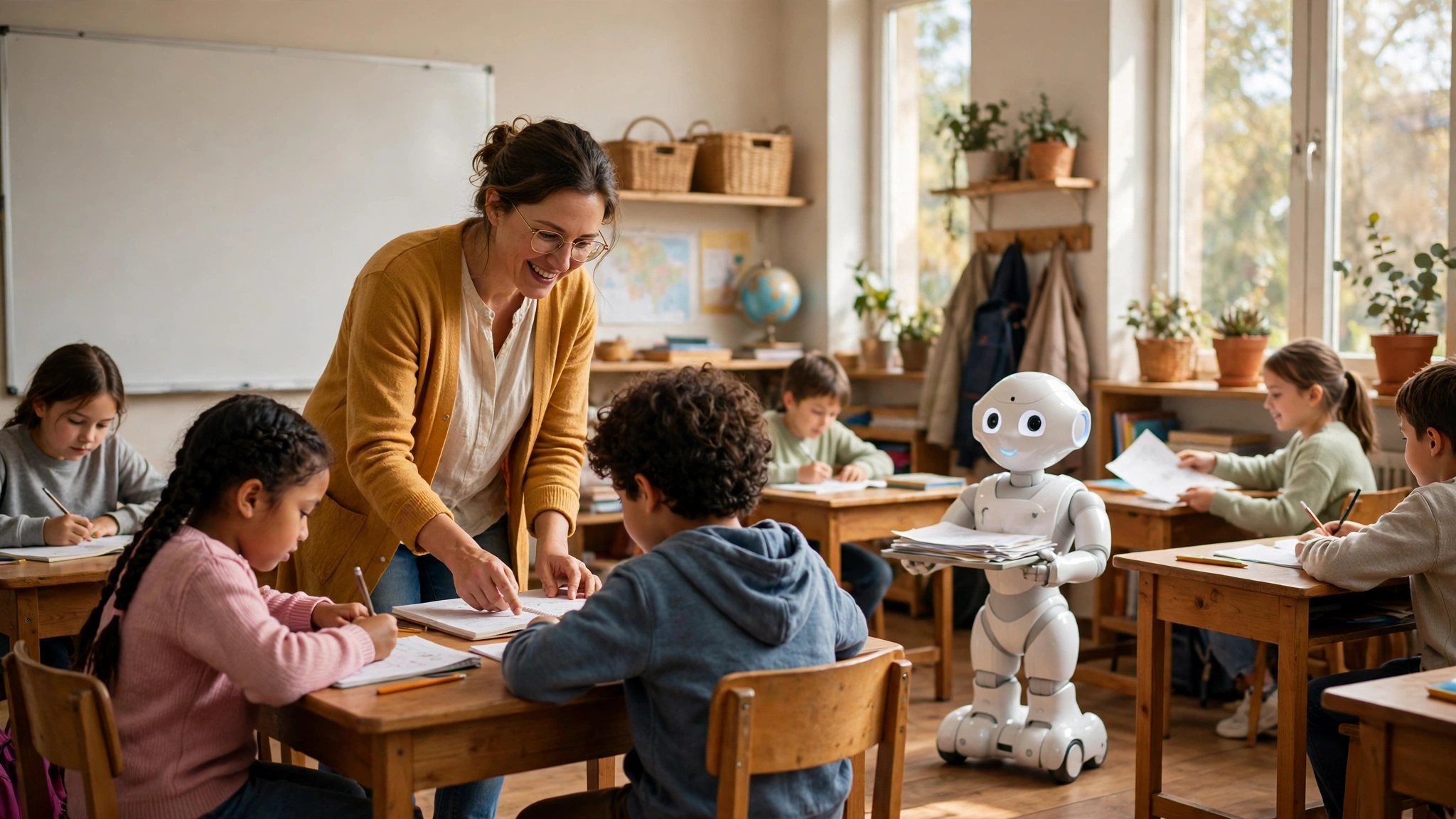
Will AI Replace Teachers? The Short Answer
No. AI will not replace teachers, not in 2027 and not on any evidence we have. UNESCO calls the idea a myth: the “teacher replacement myth”, the claim that AI will render teachers obsolete by becoming a universal tutor, is one of the high-stakes myths its researchers say must be dismantled. The world is short of teachers, not replacing them: UNESCO’s own research finds the global education system needs 44 million teachers by 2030. And in September 2026, more than 25 education ministers adopted a joint statement at UNESCO’s Digital Learning Week in Paris saying AI in schools must never replace human relationships or teacher professional judgment. AI will change teaching, and some tasks teachers do today will shrink or disappear. But the teacher’s job is not one of those tasks. This guide separates what AI can and cannot do in a classroom, explains where the real risks are, and shows how teachers are already using AI well.
The question matters because it shapes real decisions: whether a school buys AI tools, whether a teacher learns to use them, and whether a student trusts a machine to teach them. The honest answer is not that AI is useless in education. It is that AI is good at a specific set of jobs, and teaching is mostly not one of them. Our guide to AI in education looks at what is actually working in classrooms today, and this guide answers the replacement question directly.
Table of Contents
Key Takeaways
- No, AI will not replace teachers. UNESCO calls teacher replacement a myth that must be dismantled.
- The world needs 44 million more teachers by 2030, according to UNESCO research. The shortage makes replacement implausible.
- In September 2026, 25+ education ministers agreed at UNESCO that AI in schools must never replace human relationships or teacher professional judgment.
- AI is good at marking routine work, drafting lesson plans, generating practice questions and admin. It is bad at trust, motivation, judgment and relationships.
- AI can manage data transfer but cannot manage human development. Education is a social, human and cultural experience, not a technical download.
- The real risk is cognitive offloading: students letting AI do the thinking instead of thinking themselves.
- Teaching is changing, not disappearing: less marking and admin, more coaching, discussion and mentoring. Teachers decide which AI systems enter their classrooms.
What UNESCO Actually Said
The strongest evidence against teacher replacement comes from UNESCO itself, and it is unusually direct. Shafika Isaac, speaking for UNESCO in a UN News interview, named the teacher replacement myth as the first of several high-stakes myths that need dismantling: the persistent idea that AI will render teachers obsolete by becoming a universal tutor and teaching companion, and that schools can rely on AI to be responsive to every need. UNESCO’s position is that this is a fundamental category error. AI can manage data transfer, but it cannot manage human development. Education is fundamentally a social, human and cultural experience, not a technical download.
The point was made policy in September 2026. On 8 September, during UNESCO’s Digital Learning Week in Paris, more than 25 education ministers and representatives adopted a joint Ministerial Statement saying that AI in schools must never replace human relationships or teacher professional judgment, and that “learning is not served when AI substitutes for human relationships and human judgement.” The statement sets out eight priorities for action, including cultivating teacher agency: teachers must take part in decisions about which AI systems enter their classrooms, backed by investment in teacher preparation and professional development. The UN News interview with UNESCO’s Shafika Isaac explains the teacher replacement myth in UNESCO’s own words.
The same principle runs through UNESCO’s AI Competency Framework for Teachers, which was launched nationally in Egypt in July 2026 on UNESCO’s global framework. Its core message is that artificial intelligence should serve as a tool to support and empower teachers rather than replace them, and that technology should never replace teachers, it should empower them. The UNESCO ministerial statement report records the September 2026 agreement and its eight priorities.
44 Million Teachers Are Missing
The simplest argument against replacement is arithmetic. UNESCO’s research finds that the global education system needs 44 million teachers by 2030. That is not a rounding error or a distant projection: it is a shortage happening now, in classrooms that already lack teachers. Some argue that the shortage is itself a reason to invest more in AI, as a substitute for the teachers who do not exist. UNESCO calls that a category error: using AI to fill a gap is not the same as replacing the profession, and treating it as a replacement risks reducing teachers to facilitators or data managers when their real work is ethical, social and emotional.
The shortage also means the question is backwards. The problem schools face is not too many teachers being replaced by machines. It is too few teachers, doing too much admin, with too little time for the students in front of them. That is exactly the problem AI can help with, as the next section shows.
What AI Does Well in a Classroom
AI is genuinely useful for a set of teaching jobs, and teachers who use it well save real time. Here is what it does well.
- Marking routine work: quizzes, multiple-choice tests and short closed answers can be marked instantly, with feedback on the spot.
- Drafting lesson plans: a teacher can ask for a first draft of a lesson structure, then edit it to fit their class, instead of starting from a blank page.
- Generating practice questions: worksheets, quizzes and differentiated versions of the same exercise for different ability levels, produced in minutes.
- Admin: attendance summaries, parent-email drafts, report comment starters and scheduling, the paperwork that eats a teacher’s evenings.
- Instant feedback on closed questions: a student gets an answer right away, at midnight if needed, instead of waiting for the next lesson.
- Tutoring drills: repetitive practice, times tables, vocabulary, grammar exercises, where the right answer is fixed and repetition is the point.
None of these jobs is teaching in the full sense. They are the repeatable, structured work around teaching. A teacher who hands them to AI gets time back for the work only a teacher can do, which is the subject of the next section. Our guide to the best AI tools for school work covers the tools students and teachers actually use for these jobs.
What AI Cannot Do in Teaching
Here is the list that matters, because it is the list that decides the replacement question.
- Build trust and relationships: a student works harder for a teacher they trust. Trust is built over weeks of small interactions, not generated by a prompt.
- Read a room: a teacher sees the moment a class stops following, the student who has gone quiet, the joke that landed wrong, and changes course on the spot.
- Motivate a struggling student: the student who has decided they are bad at maths does not need a better explanation. They need a person who believes they can improve and proves it.
- Exercise professional judgment: deciding what a child needs, when to push and when to back off, what to say to a parent, and how to handle a sensitive situation, are judgment calls, not pattern matches.
- Teach values and ethics: honesty, kindness, fairness and courage are taught by example and by conversation, not by a model that has no values of its own.
- Handle safeguarding: noticing that a child is unhappy, unsafe or at risk, and acting on it, is a human responsibility that cannot be delegated to software.
- Adapt to a child’s emotional state: a child who arrives upset, anxious or excited needs a human response before any learning can happen.
- Model curiosity and character: students learn how to think, and how to be, partly by watching the adults around them. A machine models nothing.
Put together, this list is most of what teaching is. The parts AI handles well are the edges. The parts it cannot do are the centre. That is why UNESCO’s framing is right: AI can manage data transfer, but it cannot manage human development.
AI vs Teachers: The Comparison
| Teaching job | AI | A human teacher |
|---|---|---|
| Marking quizzes and closed answers | Excellent, instant and consistent | Slow, but sees the thinking behind the answer |
| Drafting lesson plans and worksheets | Fast first drafts | Edits them to fit real students |
| Repetitive practice and drills | Excellent, endless patience | Unnecessary for this job |
| Explaining a concept | Good, clear and available any time | Adapts the explanation to the student in front of them |
| Motivating a struggling student | Cannot do it | The core of the job |
| Reading a room | Cannot do it | Constant, instinctive |
| Professional judgment | Cannot do it | Built over years of experience |
| Safeguarding and care | Cannot do it | A legal and moral duty |
| Teaching values and character | Cannot do it | Taught by example |
| Admin and paperwork | Excellent | The part teachers most want to hand over |
The Real Risk: Cognitive Offloading
If replacement is not the risk, something else is, and UNESCO names it plainly. The risk is cognitive offloading: students letting AI do the thinking instead of thinking themselves. When a student asks AI for the answer, copies it and moves on, no learning happens. The work gets done and the understanding does not. UNESCO’s researchers see this happening more and more as AI tools spread through classrooms.
There is a second, subtler risk. What is often sold as personalisation is usually standardised individualisation: every student gets the same content at a slightly different speed, rather than a genuinely personal education. Real personalisation is a teacher who knows a student, understands what they care about, and shapes the work around that. A system that adjusts difficulty up or down is not doing the same thing, however good its marketing is.
Both risks point the same way: AI needs a teacher in the loop. The teacher is the person who makes sure the tool serves the learning instead of replacing it, who sets the tasks that require real thinking, and who notices when a student has stopped thinking and started copying. A classroom without a teacher does not get better AI. It gets worse learning.
How Teaching Is Changing Instead
So if teachers are not being replaced, what is actually changing? Three shifts are already visible.
First, the balance of the job moves. Less marking and admin, more coaching, discussion and mentoring. The teacher spends less time on the work AI does well and more time on the work only a teacher can do. That is a better job, not a smaller one, provided schools use the saved time for teaching rather than cutting staff.
Second, teachers gain a say in which AI systems enter their classrooms. The September 2026 UNESCO statement makes teacher agency an explicit priority: teachers must take part in decisions about which systems are adopted, backed by investment in preparation and professional development. That is the opposite of replacement. It is a profession being given control over its own tools.
Third, some tutoring and drill tasks shrink. A student can practise times tables with an app at home, and a teacher does not need to spend lesson time on it. But the teacher’s role in that arrangement grows, not shrinks: someone has to choose the app, check it works, notice when it does not, and connect the practice to the rest of the learning. The machine does the repetition. The teacher does the teaching.
None of this is automatic. It depends on schools, governments and teachers making deliberate choices, which is exactly what the UNESCO statement calls for. For teachers who want a practical starting point, our guides to EdTech tools for teachers and AI chatbots for schools cover tools that are already working in real classrooms.
Frequently Asked Questions
Will AI replace teachers?
No. UNESCO calls teacher replacement a myth. AI can manage data transfer but cannot manage human development, and the world needs 44 million more teachers by 2030. AI will change teaching, but it will not replace teachers.
Can AI teach better than a teacher?
For narrow, repetitive jobs such as marking quizzes and drilling practice questions, yes. For teaching in the full sense, building trust, motivating students, exercising judgment and handling care, no. AI is better at the edges of teaching and cannot do the centre.
What can AI do in a classroom?
Mark routine work, draft lesson plans, generate practice questions and differentiated worksheets, handle admin such as attendance summaries and parent-email drafts, give instant feedback on closed questions, and run tutoring drills.
What can AI never do in teaching?
Build trust, read a room, motivate a struggling student, exercise professional judgment, teach values and ethics, handle safeguarding, adapt to a child’s emotional state, or model curiosity and character.
Will teachers lose their jobs to AI?
There is no evidence of that, and the evidence points the other way: a global shortage of 44 million teachers by 2030, and a 2026 UNESCO ministerial statement from 25+ countries saying AI must never replace teacher professional judgment. Teaching roles will evolve, not disappear.
How is AI changing teaching?
Teachers spend less time on marking and admin and more on coaching, discussion and mentoring. They also gain a say in which AI systems enter their classrooms. Some drill and tutoring tasks move to apps, while the teacher’s role in choosing, checking and connecting those tools grows.
Should teachers be worried about AI?
Teachers should take AI seriously, but not as a threat to their jobs. The real worry is cognitive offloading: students letting AI do the thinking. The useful response is to learn the tools, use them for the jobs they do well, and keep the thinking with the students.
What did UNESCO say about AI replacing teachers?
UNESCO calls it the teacher replacement myth and says it must be dismantled. In September 2026, 25+ education ministers agreed that AI in schools must never replace human relationships or teacher professional judgment, and that learning is not served when AI substitutes for human relationships and human judgement.
How many teachers does the world need?
44 million more teachers by 2030, according to UNESCO’s research. The global education system is short of teachers, not replacing them.
How should teachers use AI?
Use it for marking, drafting, practice questions and admin, and keep the teaching with the teacher. Set tasks that require real thinking, check that students are thinking rather than copying, and choose tools deliberately. UNESCO’s AI Competency Framework for Teachers is a good starting point for building those skills.
Will AI replace teachers? The evidence says no, and the people who study education for a living say no, loudly and repeatedly. The better question is how teachers use AI to get their evenings back and spend more of the school day doing the work that only a teacher can do. That is a question worth answering, and it is one teachers themselves should decide. Our Tech Insights cover how AI is changing work and learning, and at Digital Discoverist we keep testing the tools so you can judge them on evidence rather than on hype.
3 thoughts on “Will AI Replace Teachers in 2027? What UNESCO and Classrooms Actually Say”