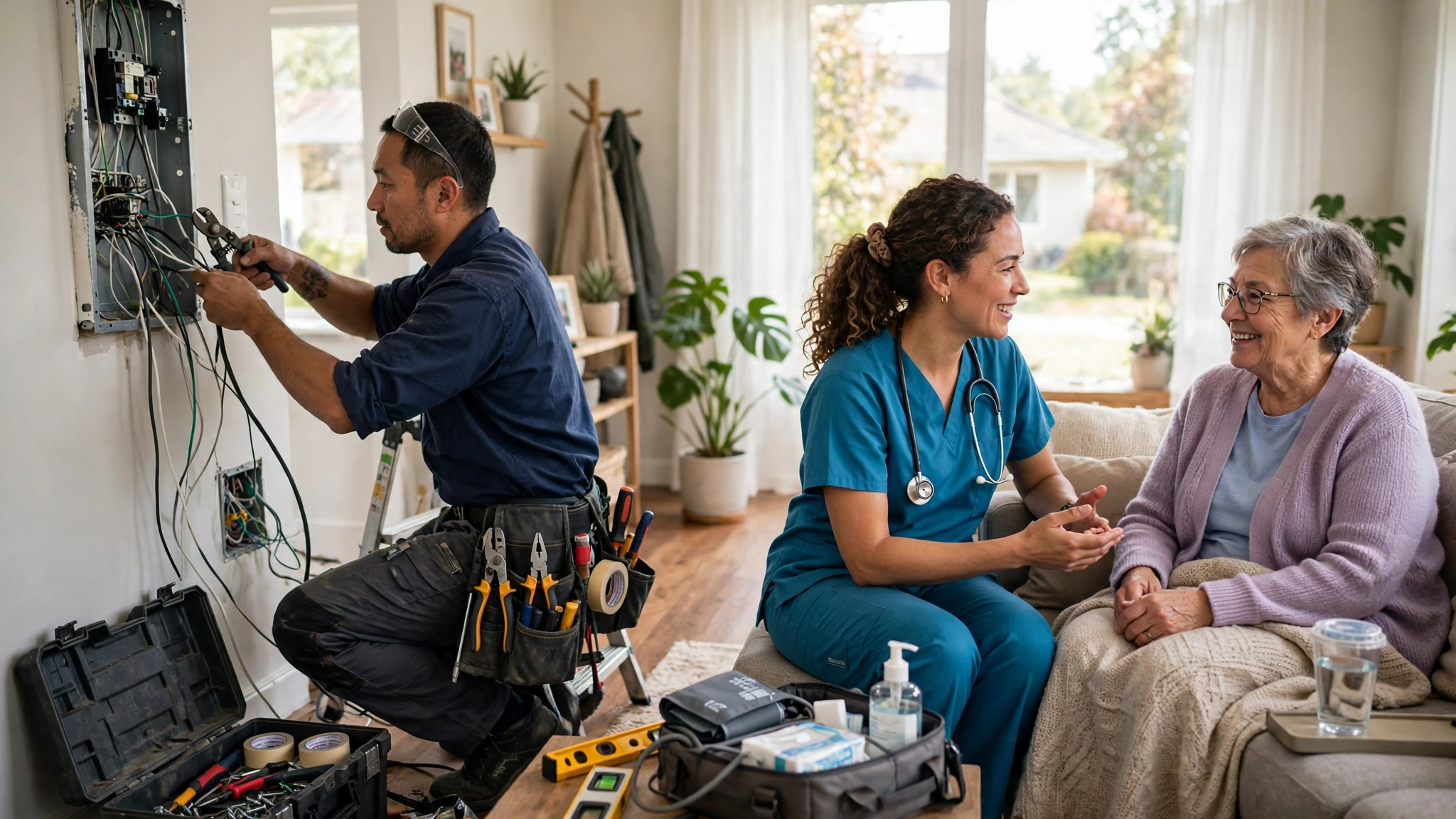
What Jobs Are Safe from AI? The Short Answer
No job is 100% safe from AI — but some jobs resist automation far better than others. The safest jobs share three traits: they need a human body in an unpredictable place, they depend on human trust and judgment, or they carry real-world accountability that cannot be handed to software. Skilled trades, hands-on healthcare, emergency work, teaching, and creative leadership all score well on those traits. The right question is not “which jobs will AI never touch” but “which jobs change least, and how do I build the skills that protect mine?” This guide answers that question honestly, without invented statistics or false guarantees.
Table of Contents
Key Takeaways
- No job is fully AI-proof. The honest question is which jobs change least — and the answer is the jobs that need physical presence, human trust, or real-world accountability.
- Skilled trades (electricians, plumbers, HVAC technicians), hands-on healthcare (nurses, physical therapists, dentists), and emergency work (firefighters, paramedics) are among the most resistant, because AI cannot do the physical work.
- Teachers, therapists, managers, and creative leaders stay safer because their work depends on relationships, judgment, and accountability — not just information.
- Knowledge jobs are not automatically doomed: developers, cybersecurity specialists, and product managers who use AI tools are safer than those who compete with them.
- AI changes even the safe jobs — it does not erase them. A nurse still nurses, but AI helps with notes; an electrician still wires houses, but AI helps with estimates.
- The best protection is not picking a “safe” job and standing still — it is building AI literacy, judgment, and human skills that AI cannot copy.
Is Any Job 100% Safe from AI?
No — and any article that promises a guaranteed AI-proof career is selling comfort, not truth. AI has already changed jobs that looked untouchable a few years ago: it drafts legal documents, writes code, reads medical scans, and answers customer questions. The technology keeps improving, so a job that is safe today may not be safe in the same form in ten years.
That does not mean every job disappears. History is useful here: ATMs did not end bank teller jobs, they changed them; spreadsheets did not end accountants, they changed what accountants spend their time on. The World Economic Forum’s Future of Jobs Report makes the same point at a global scale — it expects job creation and job displacement to happen at the same time, with new roles emerging as others shrink. The pattern is consistent: AI takes over tasks, not whole jobs, and the jobs that survive are the ones where the human parts matter most.
So the useful question is different. Instead of asking which jobs AI can never do, ask which jobs have the largest share of work that AI cannot do — and how to move your own career towards that kind of work.
The Three Traits That Make a Job Hard to Replace
Before looking at specific jobs, it helps to understand why some work resists automation. Three traits protect a job, and the more of them a job has, the safer it is.
1. Physical presence in an unpredictable place
AI lives in software. It cannot climb into a roof space, hold a patient steady, or walk a chaotic construction site. Any job that needs skilled hands in a place that changes every day — a different house, a different patient, a different emergency — is hard to automate, because the work cannot be reduced to a screen and a keyboard.
2. Human trust and judgment
Some work is trusted because a human does it. A patient trusts a nurse’s reassurance, a client trusts a lawyer’s judgment, a parent trusts a teacher with their child. AI can supply information, but it cannot be trusted in the same way — and when the decision is about health, money, freedom, or a child’s future, people want a human to own it.
3. Accountability for real-world consequences
When something goes wrong, someone has to be responsible. A surgeon is accountable for the operation, an electrician for the wiring, a pilot for the flight. AI cannot be sued, fired, or held responsible, so the human who signs off on the work stays essential even when AI helps with the preparation.
Judge any job by these three traits and you can estimate its safety for yourself, without needing anyone’s list.
What Jobs Are Safe from AI in 2027?
These are the broad groups where the three traits are strongest, with the reasons why. Job outlooks change, so treat the categories as a guide and check current figures with the US Bureau of Labor Statistics Occupational Outlook Handbook before making a career decision.
| Job group | Example jobs | Why it resists AI |
|---|---|---|
| Skilled trades | Electricians, plumbers, HVAC technicians, carpenters | Skilled hands in a different building every day; unpredictable physical work |
| Hands-on healthcare | Nurses, physical therapists, dentists, surgeons | Physical care, patient trust, and accountability for health outcomes |
| Emergency services | Firefighters, paramedics, police officers | High-risk, unpredictable situations needing instant human judgment |
| Education | Teachers, special education staff, trainers | Relationships with students, motivation, and classroom judgment |
| Personal services | Hairdressers, childcare workers, personal care aides | Physical presence and personal trust |
| Creative leadership | Creative directors, chefs, designers with a personal style | Taste, originality, and accountability for the result |
| AI-using knowledge work | Software developers, cybersecurity specialists, product managers | They use AI as a tool; judgment and responsibility stay human |
Skilled Trades: Electricians, Plumbers, and HVAC Technicians
Skilled trades are the clearest example of the physical-presence trait. An electrician wires a house that was built in 1962 with wiring no diagram matches. A plumber finds a leak behind a wall. An HVAC technician diagnoses a heating system that has been repaired five times by five different people. Every job is different, the environment is unpredictable, and the work ends with a physical result that must be safe — a badly wired house can burn down, so someone accountable has to sign off on it.
AI helps these jobs rather than replacing them: it can look up a manual, estimate a quote, or schedule appointments. But it cannot do the work itself, and that is why trades consistently appear at the top of every serious analysis of AI-resistant careers.
Hands-On Healthcare: Nurses, Physical Therapists, and Dentists
Healthcare is the other stronghold, for a different reason: trust. A nurse does not just carry out procedures — a nurse notices that a patient looks worse than the chart says, reassures a frightened family, and helps a patient move safely. A physical therapist guides a torn muscle through a movement no machine can feel. A dentist works inside a mouth with instruments that demand precise, adaptive hand control.
AI is genuinely useful in healthcare — it can flag a suspicious scan or draft clinical notes — but the hands-on, human parts are the job itself. That is also why healthcare roles appear in the World Economic Forum’s lists of growing occupations: demand for care rises as populations age, while the human core of the work stays human. For more on how AI is actually being used in care and learning, see our guide to AI in education.
Emergency Services: Firefighters, Paramedics, and Police
Emergency work combines all three protective traits at once. A firefighter enters a burning building where no two fires behave the same way. A paramedic makes a life-or-death decision in the back of an ambulance with incomplete information. A police officer reads a volatile situation and decides in seconds whether to escalate or calm it down. The work is physical, unpredictable, and carries the highest possible accountability — and it depends on human judgment under pressure, which is precisely what AI cannot do.
Teachers and Education Staff
Teaching survives for a reason that surprises people: it is not mostly about information. AI can explain algebra better than many teachers, and it can grade a quiz in seconds. What it cannot do is notice that a student has gone quiet because something is wrong at home, motivate a teenager who has decided the subject is pointless, or manage thirty different personalities in one room. The relationship is the job, and the information is only part of it.
That is also why the question “will AI replace teachers” has a more useful answer than yes or no: AI will replace the parts of teaching that are information delivery and marking, and it will leave the parts that are human — mentoring, motivation, judgment, and care. Teachers who use AI for the first part have more time for the second. Our guide to the best AI for school work shows the tools students are already using, and teachers who understand them are better placed than teachers who ignore them.
Creative Leadership and Personal Services
A creative director is hired for taste and for accountability: the client wants a human who owns the result. A chef is hired for a palate and a style no prompt can reproduce exactly. A hairdresser or childcare worker is hired for physical presence and personal trust. In each case the work is judged by a human, for a human, and the human doing it is part of the value.
AI can help all of these jobs — a designer can generate options faster, a chef can plan menus, a childcare worker can use AI for admin — but the core of the work stays human because the customer is buying a person’s judgment and presence, not just an output.
Knowledge Jobs That Work With AI
Not every desk job is at risk. Software developers are a good example: AI writes code, but a developer still decides what to build, whether the code is correct, whether it is secure, and whether it solves the real problem. Cybersecurity specialists use AI to spot threats, but a human still decides how to respond and carries the responsibility. Product managers use AI for research and drafts, but the judgment about what to build and why stays human.
The pattern is consistent: the safer knowledge jobs are the ones where AI is a tool the worker directs, not a replacement for the worker. The riskier ones are the ones where the whole job is producing routine information — and even there, the people who learn to direct AI well are the ones who stay employed.
Which Jobs Will AI Replace by 2030?
The honest answer is that AI is more likely to replace tasks than whole jobs by 2030 — but some jobs will shrink. The most exposed work is routine, predictable, and information-only: data entry, basic transcription, simple customer-service replies, routine document review, and straightforward translation of standard text. Microsoft’s 2025 study of real AI chatbot conversations found the same pattern: the occupations with the highest AI applicability were information-heavy roles such as translators, writers, and sales representatives, while hands-on occupations barely appeared.
That does not mean everyone in an exposed job loses their job. It means the job changes: the routine half gets automated, and the human half — judgment, relationships, exceptions, accountability — becomes a larger share of the work. The people at risk are not the ones in exposed occupations; they are the ones in exposed occupations who refuse to change how they work.
For a clear picture of what AI itself is and is not, see our beginner guide to the different types of AI — knowing what the technology can and cannot do is the first step to judging your own exposure honestly.
How to Make Your Own Job Safer from AI
You do not need to change careers to protect yourself. Five habits make almost any job harder to automate.
- Learn to use AI tools in your own field. The person who uses AI to do the routine half of their job is far safer than the person who ignores it. Learn the tools your profession actually uses — not AI in general, but the specific tools for your work.
- Build judgment, not just knowledge. Facts are cheap now; AI has all of them. What is valuable is knowing which facts matter, what to do when the facts conflict, and when to trust your experience over the output.
- Become the person clients and colleagues trust. Trust is earned face to face, over time, by being reliable and accountable. It is the hardest thing to automate because it is a relationship, not a skill.
- Take on the messy, unpredictable parts. Every job has routine work and exception work. Volunteer for the exceptions — the difficult client, the unusual case, the problem nobody has seen before. That is where humans stay essential.
- Keep learning in public. Take a course, get a certification, write about what you learn. Visible, current expertise is what gets you hired, and it is also what keeps you employable when your field changes.
Frequently Asked Questions About Jobs and AI
What jobs are safe from AI?
No job is fully safe, but skilled trades, hands-on healthcare, emergency services, teaching, and creative leadership resist automation best, because they need physical presence, human trust, or accountability for real-world consequences.
Is any job 100% safe from AI?
No. AI keeps improving, and every job will change. The safest jobs are the ones where the human parts — hands, trust, judgment, accountability — are most of the work, not a small part of it.
Which jobs will AI replace by 2030?
AI is most likely to replace routine, predictable, information-only tasks — data entry, basic transcription, simple customer-service replies — rather than whole occupations. Jobs shrink and change more often than they vanish outright.
Will AI replace teachers?
Not the job itself. AI can deliver information and mark work, but it cannot mentor, motivate, or manage a classroom of real students. Teaching changes — the human parts become more important, not less.
What makes a job hard for AI to replace?
Three traits: physical presence in an unpredictable place, human trust and judgment, and accountability for real-world consequences. The more of these a job has, the safer it is.
Are skilled trades safe from AI?
They are among the safest, because the work is physical, every job is different, and the result must be safe — a badly wired house or a leaking pipe needs a human who is accountable for the fix.
How can I make my own job safer from AI?
Learn the AI tools in your field, build judgment rather than just knowledge, become the person clients trust, take on the unpredictable parts of the work, and keep your expertise visible and current.
The Bottom Line
The question “what jobs are safe from AI” has no list that stays true forever — but it has a useful answer. The work that stays human is the work that needs a body in a real place, a relationship built on trust, or a person willing to be accountable for the result. Skilled trades, hands-on healthcare, emergency work, teaching, and creative leadership all have those traits in abundance, and knowledge workers who direct AI instead of competing with it join them. The safest career move is not to hide from AI but to use it for the routine half of your work while you build the judgment, trust, and human skills it cannot copy. For more on the technology behind these changes, see our different types of AI guide and the best AI tools roundup here at Digital Discoverist, and browse the Tech Insights archive for the rest of the series.
3 thoughts on “What Jobs Are Safe from AI in 2027? An Honest Answer”