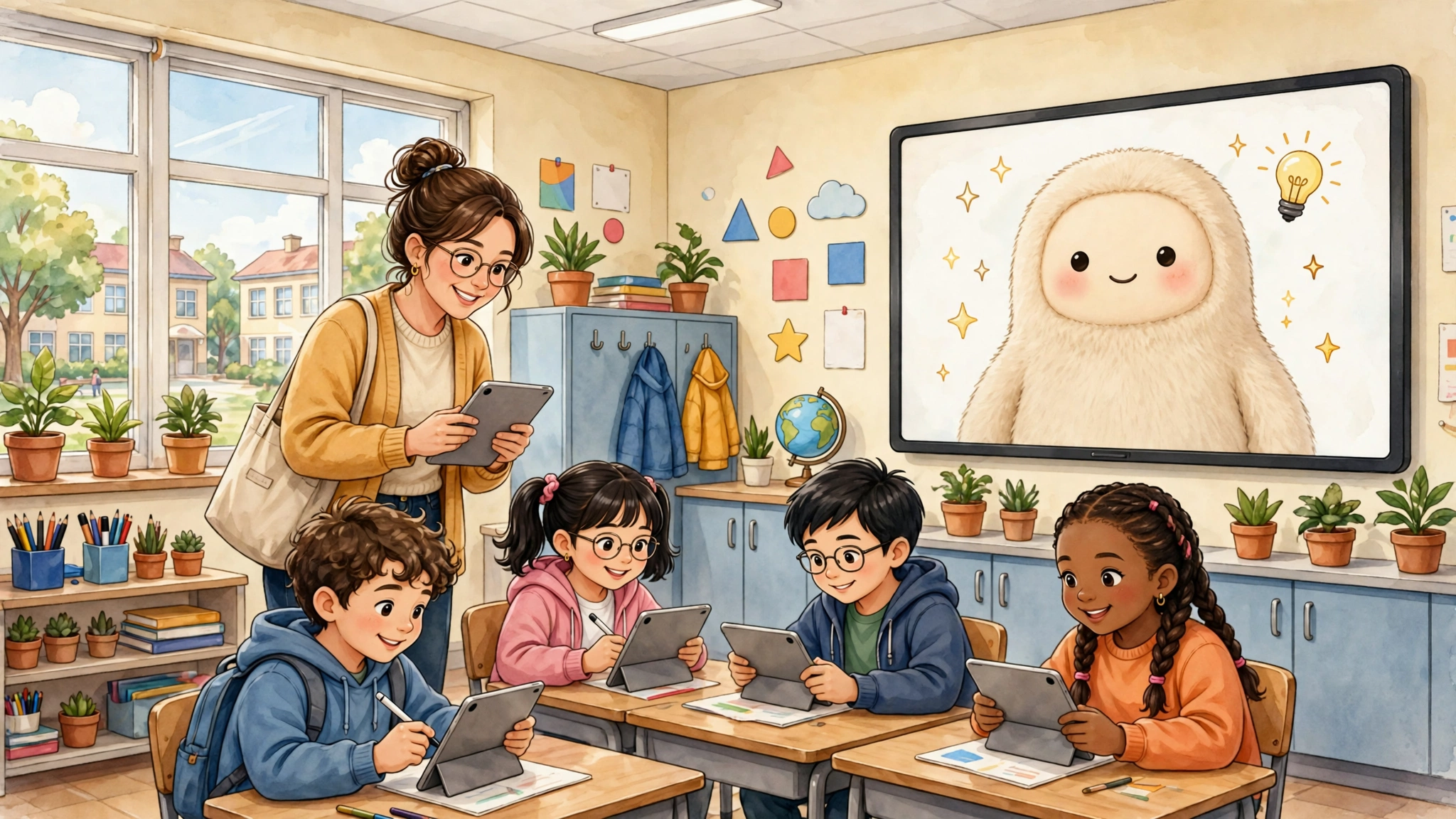
AI in education in 2027 is no longer an experiment in a few pioneering schools. It is in the classroom, the staffroom and the homework routine — drafting lesson plans, marking practice work, tutoring students after hours and reading text aloud for learners who need it. The honest picture is neither hype nor panic: artificial intelligence in education genuinely helps in some jobs, creates real problems in others, and works best when schools decide the rules before the tools decide them.
Key takeaways
- AI in education works best as a teaching assistant, not a replacement teacher — it drafts, tutors and gives feedback, while humans judge and explain.
- The strongest uses are personalised practice, faster feedback, lesson planning support and accessibility help — not handing in AI-written work.
- The real risks are cheating, wrong or biased answers, student data privacy, and over-reliance that weakens independent thinking.
- AI will not replace teachers, but teachers who use it well will set the standard for good support.
- Every school needs a short, written AI policy agreed with teachers, students and parents — before problems arrive, not after.
Direct answer: In 2027, AI in education is worth using for tutoring and practice, feedback on drafts, lesson preparation and accessibility support — with clear rules, human checking and student data protected. It is not worth using as a shortcut for assessed work, a source of unquestioned facts, or a substitute for teaching.
Table of Contents
What is AI in education?
AI in education means software that uses artificial intelligence to support teaching and learning: chatbots that answer student questions, adaptive practice apps that adjust difficulty to the learner, feedback tools, lesson-planning assistants, and accessibility features such as speech-to-text and text simplification. Unlike a fixed textbook page, the software generates or judges content.
It helps to separate three things often lumped together. First, ai for education in the broad sense: any AI tool used in a learning setting. Second, ai education tools built specifically for schools, with classroom features, safeguarding controls and curriculum alignment. Third, general-purpose AI that students and teachers happen to use for schoolwork — powerful, but without a school tool’s guardrails. For the practical side, see our guides to edtech tools for teachers and the best AI tools for school work.
How is AI used in education today?
In a school using AI well in 2027, you mostly see quiet, ordinary work. A student stuck on fractions in the evening can get a step-by-step explanation, a fresh practice question at the right difficulty, and a hint rather than the answer. This is the closest AI comes to one-to-one tutoring — most valuable for practice and revision, where instant, patient feedback genuinely helps.
Teachers use AI for faster first-pass feedback on drafts: spotting unclear paragraphs, suggesting structure, or generating quizzes from a topic. Students revise sooner, while the teacher still makes the final judgement. The rule that keeps this honest is simple: AI feedback is a draft for the teacher to check, never the grade itself.
Planning is where many teachers feel the biggest time saving: AI can draft a lesson outline, generate worksheets at several reading levels, or suggest discussion questions. The teacher then edits and corrects. Checking matters most here, because a confident-sounding plan can quietly contain a wrong fact or an activity unsuited to the age group.
Some of the least controversial uses are accessibility features: reading text aloud, simplifying a passage, translating instructions, or transcribing a lesson. For students with dyslexia, hearing difficulties or English as an additional language, these remove barriers that have nothing to do with intelligence.
| Use | Who benefits most | What to watch |
|---|---|---|
| Tutoring and practice | Students revising or catching up | Copying answers instead of working through steps |
| Feedback on drafts | Students and teachers, via faster revision | Generic feedback; AI must not set the grade |
| Lesson planning | Teachers, especially for differentiated materials | Wrong facts or age-inappropriate content unchecked |
| Accessibility support | Students with additional or language needs | Over-simplification that strips out the learning |
What are the benefits of AI in education?
The benefits of ai in education are real but specific. Personalisation at scale: a teacher with thirty students cannot give each one a different worksheet and instant feedback on every question, but software can approximate that for practice work. Speed of feedback: students learn more from a comment received the same day than one returned a fortnight later. Teacher time: planning and marking support can free hours for the work only a human can do — explaining, discussing and noticing when a student is struggling. Accessibility: reading, translation and simplification features let more students access the same curriculum. The benefit comes from pairing a capable tool with a teacher who directs it.
What are the risks and disadvantages of AI in education?
The disadvantages of ai in education deserve the same plain treatment, because each has a practical safeguard — and “ban it and hope” is not one, since students will use these tools at home anyway.
Cheating and shortcut learning
The most visible risk is a student submitting AI-written work as their own and learning nothing. The safeguard is assessment design, not just detection tools, which are unreliable and can falsely accuse students. Schools are shifting assessed work towards in-class writing, oral explanation, process evidence such as drafts, and questions asking students to apply ideas to a new situation. If a task can be completed perfectly by pasting it into a chatbot, the task needs redesigning.
Wrong, biased or made-up answers
AI can produce confident, fluent answers that are simply wrong, and can reflect biases in its training data — stereotyped examples, or uneven quality across languages and dialects. The safeguard is a classroom culture of checking: verify important claims against a textbook, a trusted source or the teacher, and never cite an AI answer as evidence on its own. Teachers should model this by visibly correcting AI output in class.
Privacy, over-reliance and unequal access
Free consumer AI tools may use entered text to improve their systems, so pasting student names, essays or school records into them is a genuine safeguarding issue. The safeguard is an approved-tools list: only tools the school has checked for data handling and safeguarding should be used for schoolwork. Over-reliance is the quieter risk: learn the skill first with AI switched off, then use AI to practise or check. Finally, not every student has a device or connection at home, so schools should provide access in school time and never grade a student on a tool they cannot reach.
Will AI replace teachers?
No — and this is one question where the answer is clear. Teaching is not mainly information delivery; it is judging what a student understands, motivating them, managing a room, and building the relationship that makes a student willing to try something hard. AI does none of that. What AI does well — drafting, drilling, instant feedback, summarising — is the supporting work around teaching. The risk is not replacement but de-skilling: a school leaning on AI without protecting teacher judgement ends up with thinner teaching.
Where AI in education still fails
The failures are predictable. AI struggles with new or local knowledge and may invent plausible-sounding details about a niche subject. It is weak at judging quality: it cannot reliably tell a strong student argument from a fluent weak one, and its feedback can reward surface polish over real understanding. It handles open-ended and moral questions poorly, because those have no single correct answer. Keep AI in jobs where its failures are visible and cheap — a draft that gets read, a practice question that gets checked — and out of jobs where failure is hidden and costly, such as final grades or safeguarding decisions.
How should schools use AI responsibly?
A responsible approach needs a short, shared agreement: an approved tools list with privacy checks done; acceptable use defined as help with learning, not substitution for it; assessment designed so AI shortcuts do not work; staff training before rollout; and a termly review to drop tools that are not helping. Official guidance is a useful starting point: UNESCO’s work on AI in education and the US Department of Education’s guidance both emphasise human oversight, equity and privacy — see UNESCO’s AI in education pages and the US Department of Education’s AI guidance. For classroom chatbots, see our guide to school AI chatbots.
Checklist for teachers and schools
- Use only school-approved tools for student work; keep personal data out of unapproved ones.
- Read and edit every AI draft before it reaches students — check facts and age-appropriateness.
- Build at least one AI-resistant check into assessed work: in-class writing, oral explanation or process evidence.
- Teach checking explicitly, and sequence learning before AI use: practise the skill first, then use AI to extend it.
- Publish a short AI policy for parents, revisit it each term, and provide an in-school route for any task.
What parents should ask about AI at school
Parents do not need to understand the technology to ask good questions: Which AI tools does the school approve, and what student data do they hold? How is assessed work protected from AI shortcuts — and from false accusations? How does the school teach children to check AI answers rather than trust them? What happens if we do not have AI access at home? And who do I contact if I am concerned? A school with good answers to those five questions has thought this through. See also our guides to AI for school work and how to learn machine learning.
What is the future of AI in education?
The future of ai in education is likely quieter and more embedded than the headlines suggest. Expect AI to fade into ordinary school software — a tutor inside the learning platform, feedback built into the writing tool, accessibility features switched on by default. Expect assessment to keep changing, with more emphasis on what students can do in person and explain aloud, because that is what AI cannot fake. Expect guidance to tighten around children’s data, favouring school-built tools over consumer chatbots. The deciding factor is not the technology but the judgement around it: which jobs AI does, which jobs humans keep, and how students learn to tell the difference. That judgement is the real change of 2027.
Frequently asked questions
Can teachers tell if a student used AI?
Not reliably from detection tools alone, which can be wrong in both directions. Teachers are far more reliable when they ask the student to explain the work and design tasks AI cannot complete unaided.
Is AI in schools safe for children?
Approved school tools with safeguarding controls are much safer than open consumer chatbots. The key protections are the approved-tools list, adult supervision, and teaching students never to share personal information with an AI tool.
2 thoughts on “AI in Education in 2027: What Is Actually Working in Classrooms”