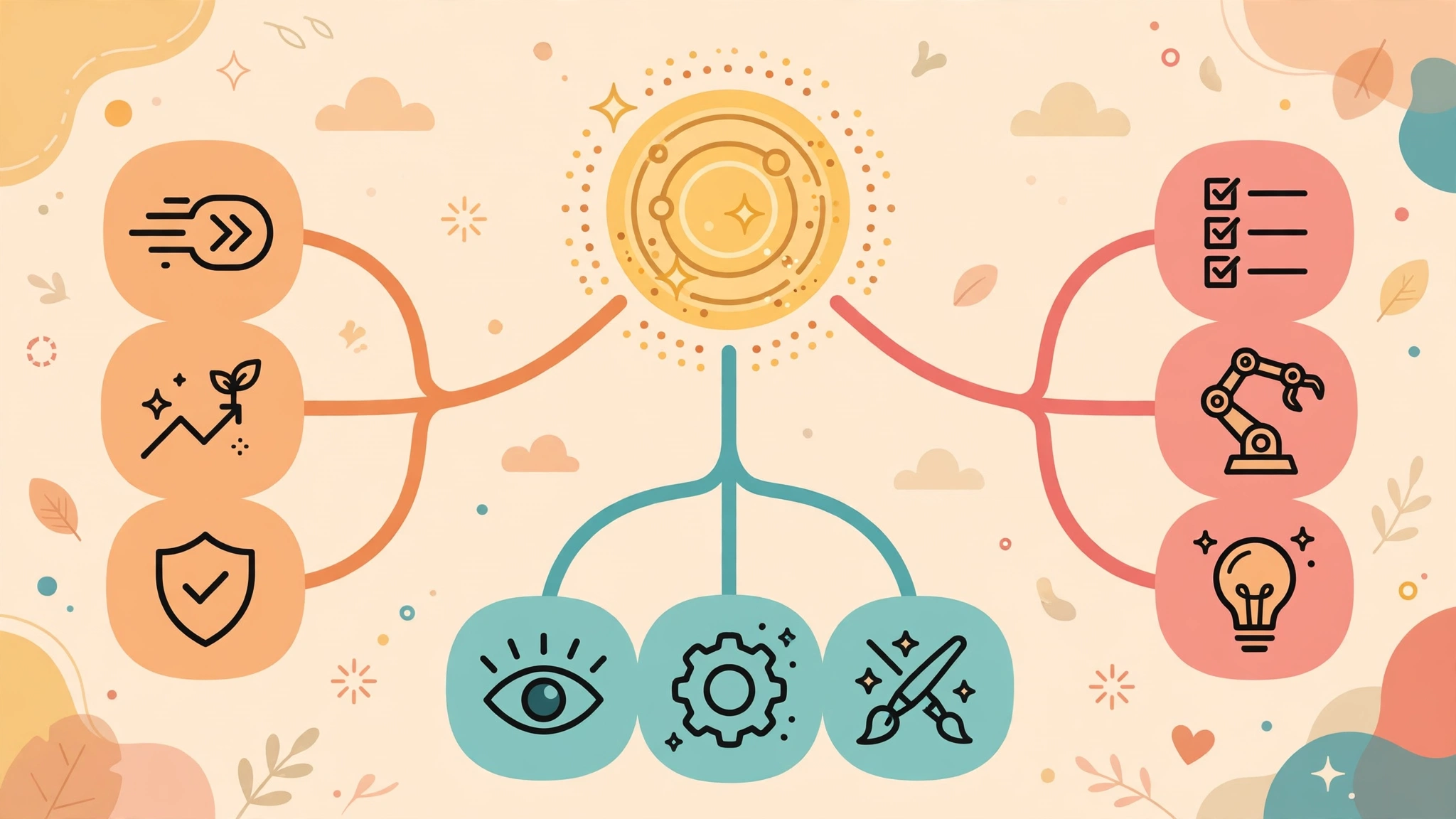
“AI” is not one thing. When people argue about whether AI is overhyped, dangerous or about to replace jobs, they are usually talking about a different types of AI without realising it. The different types of ai are described in three separate ways — by how capable a system is, by how it uses memory and information, and by the job it does — and mixing those three lenses together is what makes most explainers confusing. This guide keeps the three lenses separate, says plainly which types exist today and which are still hypothetical, and gives an everyday example for each.
Table of Contents
Key takeaways
- “Types of AI” means three different things: capability (how broadly it can think), function (how it uses memory), and job (what it does).
- Every AI system in use today is narrow AI — built for specific tasks, however impressive it looks.
- General AI (AGI) and superintelligence (ASI) are theoretical; no such system exists, and researchers disagree on if or when they will.
- Most modern AI is “limited memory” AI: it learns from recent data, but it does not remember you the way a person does.
- Generative AI, predictive AI and AI agents are jobs, not capabilities — a generative system is still narrow AI.
Direct answer: The main types of AI by capability are narrow AI (exists — everything you use today), general AI (theoretical — human-level across tasks) and superintelligence (hypothetical — beyond human ability). By function they are reactive machines, limited memory AI, theory-of-mind AI and self-aware AI — only the first two exist. By job, the types you will actually buy or use are generative AI, predictive AI, classifiers, recommenders and AI agents. Keep those lenses apart and most AI confusion disappears.
Why are there three different lists of AI types?
Imagine describing vehicles by size (bicycle, car, lorry), by engine (petrol, electric, diesel) and by job (delivery, racing, farming). All three lists are true, and none of them replaces the others. AI works the same way. Capability asks: how broadly can this system think? Function asks: how does it handle information and memory? Job asks: what is it for? A chatbot can be narrow AI (capability), limited-memory AI (function) and generative AI (job) all at once — three true labels from three lenses. Confusion starts when an article lists “narrow AI, machine learning, chatbots and AGI” as if they were four items in one list. They are not; they belong to different lenses.
Types of AI by capability: narrow, general, super
| Type | What it means | Status in 2027 | Example |
|---|---|---|---|
| Narrow AI (ANI, “weak AI”) | Excellent at one task or a narrow set of tasks; cannot generalise beyond them | Exists — all AI today | ChatGPT, Siri, spam filters, chess engines |
| General AI (AGI, “strong AI”) | Human-level ability across many tasks, learning new skills without retraining from scratch | Theoretical — in research | None yet |
| Superintelligence (ASI) | Abilities surpassing humans across the board | Hypothetical | None; science fiction for now |
What is narrow AI?
Narrow AI is designed for a specific purpose and performs that purpose extremely well — often better than a human — but it cannot step outside its scope. A chess engine cannot write an email. A translation model cannot drive a car. Even the most capable chatbots are narrow in this sense: they handle language tasks broadly, but they do not genuinely understand the world, hold beliefs, or transfer their skill to an unrelated domain without new training. “Weak AI” sounds insulting, but it is a technical term, not a judgement — narrow AI runs the modern world, from search ranking to fraud detection to medical image screening.
What is general AI (AGI)?
Artificial general intelligence would use previous learning to accomplish new tasks in a different context, the way a person who learns to cook can apply timing, planning and taste to a recipe they have never seen. No AGI exists. Researchers disagree sharply on how far away it is — estimates range from years to decades to never — and that disagreement itself is useful information: anyone who tells you AGI has arrived, or gives a confident arrival date, is selling something, not reporting a fact.
What is superintelligence (ASI)?
Superintelligence would think, reason, learn and judge at a level surpassing humans. Like AGI, it is strictly theoretical today. It matters in policy and safety debates, but it should not shape your buying decisions: no product you can buy in 2027 is superintelligent, and no vendor claim should be read that way.
Types of AI by function: how systems use memory
| Type | How it works | Status | Example |
|---|---|---|---|
| Reactive machines | Responds only to current input; stores no memory, learns nothing from experience | Exists | IBM Deep Blue (chess), simple rules engines |
| Limited memory AI | Uses recent data temporarily to inform decisions; learns from training data | Exists — most modern AI | Chatbots, self-driving cars, recommendation systems |
| Theory of mind AI | Would understand emotions, beliefs and intentions of others | In early research | Experimental social robots |
| Self-aware AI | Would have consciousness, self-awareness and sentience | Hypothetical | None |
The function lens explains a common surprise: why a chatbot that seems to “remember” you is still limited-memory AI. It may keep a short conversation history or a stored profile, but it does not build the kind of continuous, personal memory a human has. When the session ends or the context is cleared, most of that “memory” goes with it. That distinction matters for privacy: do not share sensitive information with a chatbot on the assumption that it will forget it the way a person might, or remember it the way a person would.
Types of AI by job: what you actually buy or use
The job lens is the one that matters when you choose a tool. These are not capability levels — they are what the system is built to do, and every one of them today is narrow AI:
- Generative AI: creates new content — text, images, code, music — from a prompt. Examples: ChatGPT, image generators, code assistants.
- Predictive AI: forecasts an outcome from past data — sales, churn, demand, risk. Used in finance, retail and operations.
- Classifiers: sort input into categories — spam or not spam, fraud or legitimate, a tumour or not. The workhorse of applied AI.
- Recommenders: suggest what you might like next — Netflix, Spotify, shopping sites. A special kind of prediction, tuned for personalisation.
- AI agents: carry out multi-step tasks with some autonomy — booking, researching, acting across tools. The newest job type, and the one to vet most carefully for permissions and mistakes.
When a vendor says “our AI”, ask which job it does. A generative tool will not predict sales well, a classifier will not write your newsletter, and an agent that can book travel is not a sign that general AI has arrived. Generative tools in particular raise data issues, covered in our generative AI data challenges guide.
Machine learning, deep learning and neural networks — where do they fit?
Machine learning is not a type of AI; it is how most modern AI is built — systems that learn patterns from data instead of following only hand-written rules. Deep learning is a kind of machine learning that uses large neural networks, loosely inspired by how brains process signals, to learn complex patterns from large amounts of data. A neural network is the underlying structure: layers of connected units that adjust their weights as they train.
Put simply: AI is the goal, machine learning is the method, deep learning is a powerful method within it, and a neural network is the structure that does the learning. For a plain-language walkthrough of that structure, see our neural network explainer. You do not need the maths to use these tools well — but knowing that “deep learning” is a method, not a separate kind of AI, stops a lot of marketing confusion.
Which type of AI should you care about?
For almost everyone reading this, the answer is narrow, limited-memory AI doing a specific job — generative, predictive, classifier, recommender or agent. That is what you can buy, use and evaluate today. AGI and ASI are worth knowing about because they shape headlines and policy, but they should not shape a purchase: if a product claims to be “general AI” or “superintelligent”, treat that as marketing, not a capability description.
A practical test for any AI product: what job does it do, what data does it learn from, what happens when it is wrong, and who is responsible for its mistakes? A tool that answers those four questions clearly is usually a sound narrow-AI product. A tool that answers with “it’s general AI” has not answered them at all.
Frequently asked questions
What are the 3 main types of AI?
By capability, the three are narrow AI, general AI (AGI) and superintelligence (ASI). Only narrow AI exists today; AGI and ASI are theoretical or hypothetical.
What are the 4 types of AI by function?
Reactive machines, limited memory AI, theory-of-mind AI and self-aware AI. Only the first two exist in practice; the last two are research or hypothetical.
Is ChatGPT general AI?
No. ChatGPT is narrow, limited-memory, generative AI. It handles language tasks broadly, but it cannot genuinely understand the world or transfer its skills to unrelated domains without new training.
What is the difference between narrow AI and weak AI?
None — “weak AI” is another name for narrow AI, meaning AI built for specific tasks. “Strong AI” is another name for general AI.
Once you separate capability, function and job, the different types of ai stop being a confusing list and become a useful map: narrow AI is what exists, limited-memory AI is how most of it works, and generative, predictive and agent systems are the jobs you will actually use. Start there, and ignore any claim that skips those distinctions. For more on what AI is actually for, see our what AI is actually for guide and our questions about AI explainer, and for tools, see our best AI tools guide. External reading: IBM Think’s AI overview and Arcitech’s types of AI guide. For more guides in this area, explore our Tech Insights guides.
2 thoughts on “Different Types of AI Explained in 2027: A Simple Beginner Guide”