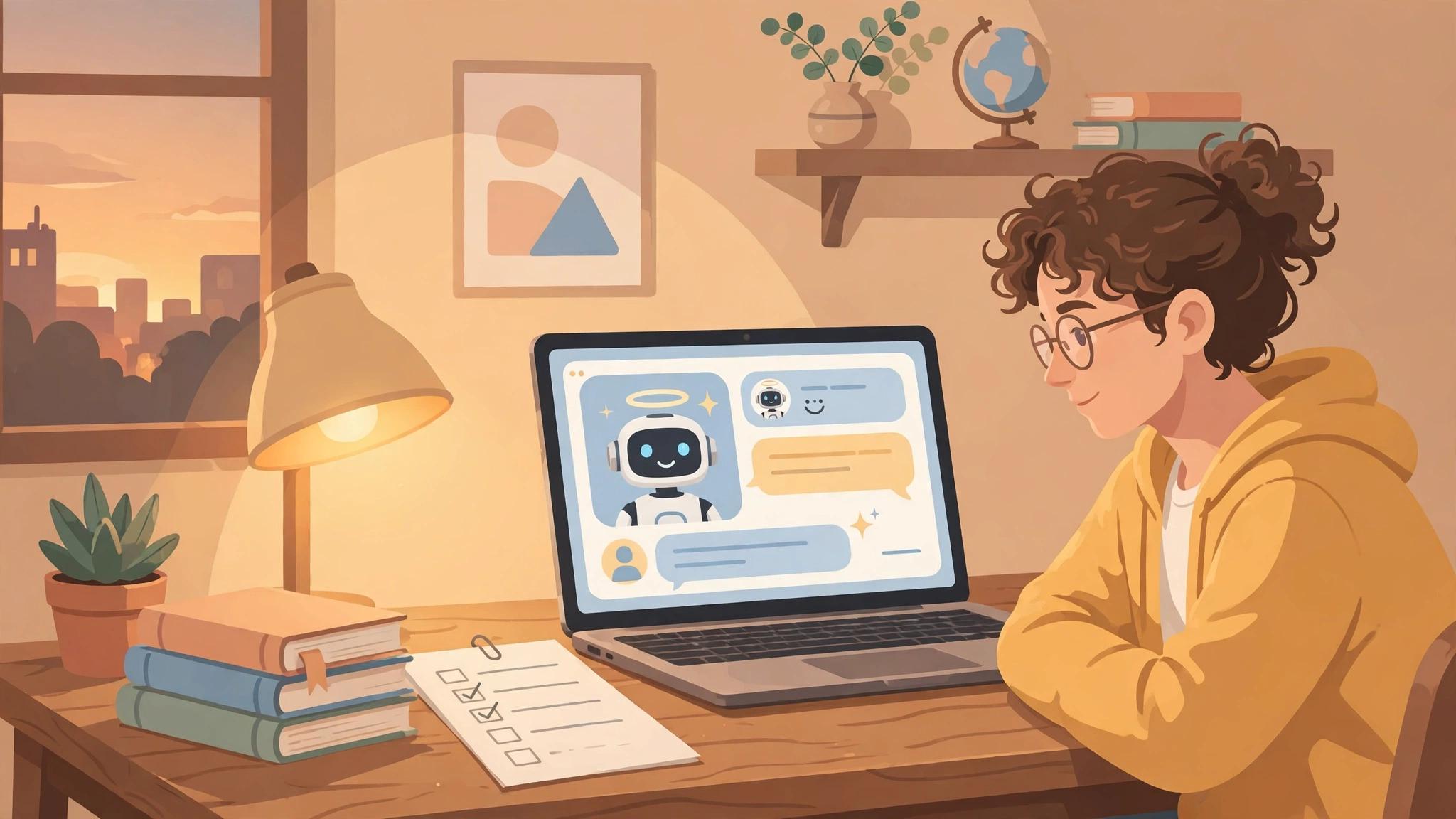
How Do You Actually Learn a New Skill?
Learning how to learn new skills comes down to four moves: pick one skill and define what “good enough” looks like, build a short plan around practice rather than watching, use AI as a tutor that quizzes you instead of handing you answers, and review on a schedule so the skill sticks. That is the whole method. Everything else — which app, which course, which AI assistant — is a detail that serves those four moves or gets in their way.
Most people fail at a new skill for the same reason: they confuse consuming information with learning. Watching ten hours of tutorials feels like progress, but a week later almost nothing is left, because nothing was ever retrieved, practised or explained back. AI makes this worse and better at the same time. Used as an answer machine, it lets you finish exercises faster while learning less. Used as a tutor, it is the most patient teacher most people will ever have — available at midnight, never tired of your questions, able to quiz you, check your explanations and build you a plan. This guide shows you how to learn new skills with AI in the second way, with the learning science that makes it work and copy-paste prompts you can use today.
Table of Contents
Key Takeaways
- Learning how to learn new skills starts with a goal, not a course: name the skill, define “good enough” in one sentence, and give yourself a first project.
- Retrieval practice — testing yourself instead of re-reading — is the highest-value technique. Students who self-test retain 50–80% more a week later than students who re-read for the same time.
- The first 20 hours of focused practice take you from nothing to reasonably good at most skills. Build a 20-hour plan and protect it.
- AI helps when it asks you questions and hurts when it answers yours. A Harvard trial found an AI tutor that asked guiding questions more than doubled learning gains; a 2026 study of 3.2 million student interactions found test scores fell about 25% after AI-assisted practice once the tools were removed.
- Use the 70/20/10 guideline: about 70% practice, 20% feedback, 10% theory. If your week is mostly theory, you are not learning yet.
- Copy the prompts in this guide — a 20-hour plan, an adaptive quiz, a Feynman check, a learning ladder and a Socratic tutor — and run them with ChatGPT, Claude or Gemini.
Step 1: Pick One Skill and Define “Good Enough”
Before you open a course or an AI chat, answer three questions on paper. What is the skill? What does “good enough” look like in one sentence? What is the first real thing you will make or do with it? If you cannot answer the third question, you have picked a topic, not a skill — and topics do not get learned, they get read about.
“Learn Python” is a topic. “Write a script that renames and organises the photos in my folders” is a skill with a finish line. “Learn Spanish” is a topic. “Hold a five-minute conversation about my weekend” is a skill with a finish line. “Learn design” is a topic. “Design a poster for my friend’s café” is a skill with a finish line. The finish line matters because it decides everything downstream: which concepts you need, which you can skip, and when you are done with the beginner phase.
One skill at a time. Learning how to learn new skills is mostly learning how to protect your attention from the second skill that looks more exciting in week two. If a second skill tempts you, write it on a list for later and keep going. The list will still be there in a month, and you will actually have the first skill by then.
Step 2: Build a 20-Hour Plan with AI
Josh Kaufman’s well-known idea is that the first 20 hours of deliberate practice take you from nothing to reasonably good at most skills. Twenty hours is small enough to be real: ten two-hour sessions, or twenty one-hour sessions across a month. The plan is what turns “I want to learn this” into a schedule, and AI builds a better first plan than a blank page does.
Copy this prompt into ChatGPT, Claude or Gemini, and fill in the brackets. That is the first practical answer to how to learn new skills: a plan built around practice, not a reading list.
“I want to learn [skill]. My goal is [one-sentence finish line]. I can study [number] hours a week. Build me a 20-hour plan focused on the 20% of concepts that drive 80% of results. Break it into 10 two-hour sessions. Each session should have one concept, one concrete practice task, and a short review at the end. Tell me what to skip.”
The last sentence is doing real work: a good plan tells you what to ignore, because the beginner’s biggest enemy is the full syllabus. You do not need all of music theory to play your first song, all of grammar to hold your first conversation, or all of Python to automate one folder of photos. If the plan it returns looks like a textbook table of contents, ask it to cut it in half and keep only what the first project needs. Our how to learn machine learning guide shows what a realistic beginner roadmap looks like when the scope is honest — use it as a model for judging the plan AI gives you.
Step 3: Make the AI Quiz You, Not the Other Way Round
Here is the single biggest difference between using AI for answers and using it for learning. Decades of research point to one conclusion: retrieval practice — pulling information out of your memory — is one of the most powerful ways to learn. Students who test themselves retain 50–80% more a week later than students who re-read the same material for the same amount of time. Reading feels productive because the material looks familiar. Testing feels hard because it exposes what you do not know. The hard feeling is the learning.
Turn your AI assistant into a quizmaster with this prompt:
“Quiz me on [topic] one question at a time. Wait for my answer before the next question. If I am right, make the next question a bit harder. If I am wrong, explain briefly, then ask a similar question so I can prove I have got it now. Mix in questions that make me connect ideas, not just recall facts.”
Run the quiz at the start of a session, not the end. If you remember one thing about how to learn new skills, make it this: testing beats re-reading. Five minutes of retrieval before you study new material does more than thirty minutes of re-reading your notes. And if you are learning something with a right answer — a language, coding, music theory — ask the AI to keep a running score and to re-test your misses two days later. That is spaced repetition without buying a flashcard app: the re-test after a delay is what moves knowledge from short-term memory into the kind that survives a weekend.
Step 4: Explain It Back — the Feynman Check
The Feynman technique is named after the physicist Richard Feynman, and it is brutally simple: if you cannot explain something in plain language, you do not understand it yet. AI makes this loop easy to run, because it is a tireless audience that can tell you exactly where your explanation breaks down.
After each study session, explain the day’s concept to the AI as if teaching a smart twelve-year-old, then paste this prompt:
“I am going to explain [concept] in my own words. Stop me the moment I get unclear or wrong, ask one question that exposes the gap, reteach that piece, then make me explain it again. Repeat until my explanation is clean.”
What usually happens is humbling: the explanation that sounded clear in your head falls apart at the second sentence. That is the technique working. The gap it found is the exact thing to study next, which is far more useful than re-reading the whole chapter. Do this once per session and your understanding compounds — you stop collecting half-understood concepts and start building a chain where each link holds.
Step 5: Learn by Building, Not by Watching
For hands-on skills — coding, writing, design, a language, music — the fastest progress comes from projects, not tutorials. Watch one short explanation, then immediately use the idea. Want to learn web development? Build a personal portfolio website instead of watching fifty tutorials. Want to learn graphic design? Create a logo for an imaginary brand. Want to learn a language? Write and record a two-minute introduction about yourself.
Ask the AI to structure project-based learning for you:
“I am learning [skill] by building [project]. Break the project into five milestones. For each milestone, tell me the one concept I need, the smallest version of the task that proves I can do it, and the mistake beginners usually make here.”
The 70/20/10 guideline is a useful check on your week: about 70% practice, 20% feedback, and 10% theory. Those percentages are a practical rule of thumb, not a fixed scientific formula — different subjects need different amounts of theory — but the direction is right. If your week was mostly theory, you were preparing to learn, not learning. A real project also gives the AI something concrete to review: paste your code, your paragraph or your design and ask for the two biggest problems and one concrete fix. Specific feedback on real work beats general advice every time.
Which AI Tool Fits Which Skill?
Any major assistant can tutor, but they have different strengths, and matching the tool to the skill saves you friction. This is the short version of how to learn new skills with the right assistant for the job.
| Skill type | Best AI approach | Why |
|---|---|---|
| Coding and automation | ChatGPT or Claude with a project | Explains errors line by line, reviews real code, and keeps context across sessions in a project folder |
| Languages | Gemini or ChatGPT voice mode | Spoken conversation practice with instant correction; ask it to reply only in the target language |
| Exams and school subjects | ChatGPT Study Mode | Built for guided practice and Socratic questions instead of direct answers — see our ChatGPT Study Mode guide |
| Writing and communication | Claude with Learning Mode | Socratic questioning that guides you toward the insight instead of rewriting your draft for you |
| Design and visual skills | Gemini image tools + a course | Generate references and variations fast, then practise by recreating them yourself |
| Music and creative skills | Any assistant + a practice routine | AI explains theory and builds exercises, but the skill lives in your hands — practise daily, even briefly |
If you prefer structured courses to self-directed tutoring, a course platform is still the right call — our best online AI courses roundup and our Google AI courses guide cover the free and paid options, including Coursera and Khan Academy for general learning. The method in this guide works with a course too: use the course for the 10% theory, and use AI for the quizzing, the Feynman checks and the feedback on your projects.
The Answer Trap: When AI Makes You Worse
This is the part most guides on how to learn new skills skip, and it is the part that decides whether the method works. There is now real evidence on both sides, and you should know both numbers before you trust an AI tutor.
On the positive side, a Harvard randomised controlled trial, published in Nature Scientific Reports in June 2025, found that an AI tutor engineered to ask guiding questions — to scaffold content and use active recall rather than deliver explanations — produced more than double the median learning gains of active classroom learning. The tutor worked because it facilitated discovery instead of delivering answers. The same idea sits behind OpenAI’s ChatGPT Study Mode, which is built around guided practice and step-by-step questions rather than straight answers.
On the negative side, a May 2026 analysis of 3.2 million student interactions on the ALEKS learning platform found that after ChatGPT’s release, students finished AI-susceptible problems about 27–31% faster — and their test performance fell by about 25% once the AI tools were removed. They were faster with help and weaker without it. The researchers’ name for this is the dependency effect: the tool did the thinking, so the student never did.
The difference between the two results is the mode you are in. Answer-seeking mode — “give me the solution” — makes you faster today and weaker next week. Learning mode — “quiz me”, “ask me questions”, “make me explain it” — is slower in the moment and stronger afterwards. Before every session, say out loud which mode you are in. If you catch yourself copying an answer you could not reproduce alone, delete it and redo the problem with the AI asking the questions. And for anything precise or important, verify the AI’s facts against a reliable source — AI can be confidently wrong, and a wrong fact practised ten times is harder to unlearn than a fact never learned.
A One-Week Starter Plan for Learning How to Learn New Skills
If you want a concrete starting point for how to learn new skills, here is the whole method compressed into one week. Pick your skill and your finish line on day one, then run the same loop every day: retrieve, learn one new thing, explain it back, practise it in your project, and review your misses.
| Day | Do this (30–60 minutes) |
|---|---|
| Day 1 | Define the skill and finish line. Ask AI for the 20-hour plan. Do session one. |
| Day 2 | Five-minute quiz on day one, then session two. Start the project — the smallest version. |
| Day 3 | Quiz on days one and two. Feynman-check yesterday’s concept. Session three. |
| Day 4 | Project milestone one. Ask AI for the two biggest problems and one fix. |
| Day 5 | Quiz on everything so far, including misses. Session four. Build the learning ladder: five levels from beginner to advanced, with a milestone that proves each level. |
| Day 6 | Project milestone two. Explain the whole project so far to the AI and let it find the gaps. |
| Day 7 | Rest day with a ten-minute quiz. Review the week: what stuck, what did not, and what the plan for week two should cut or add. |
After that week you will know something no amount of reading can tell you: whether the skill is one you actually enjoy doing, and whether your plan is working. Adjust the plan, keep the loop, and repeat. That is how to learn new skills — not in a burst of motivation, but in a loop that survives the week motivation runs out.
Frequently Asked Questions
How long does it take to learn a new skill?
It depends on the skill and the standard. The first 20 hours of focused practice take most people from nothing to reasonably good at most skills — good enough to do something real with it. Fluency or professional level takes far longer, usually months of regular practice. Set the “good enough” line first, or the answer is always “longer than you hoped”.
Can AI really help me learn a new skill?
Yes, when it tutors instead of answering. An AI that quizzes you, asks Socratic questions and checks your explanations accelerates learning — a 2025 Harvard trial found more than double the learning gains from that kind of tutor. An AI that just gives you answers makes you faster and weaker, as the ALEKS study showed.
What is the best way to learn new skills online?
The honest answer to how to learn new skills online is to combine three things: a short course or guide for structure, an AI tutor for quizzing and feedback, and a real project for practice. Courses alone leave you with watched hours and no skill; AI alone leaves you with answers and no structure; projects alone leave you guessing. Together they cover the loop.
How do I stay motivated while learning a new skill?
Motivation follows progress, not the other way round. Small daily sessions you actually finish beat heroic weekend sessions you dread. Track streaks, make the project something you care about, and review your misses — visible progress is the fuel. If you miss a day, restart the next day without doubling up to “catch up”.
How do I learn a skill with only 30 minutes a day?
Thirty focused minutes a day is enough for most skills. Use five minutes for a retrieval quiz, twenty minutes for one concept plus one practice task, and five minutes for a Feynman check. The key is daily, not long — spaced daily practice beats a weekly three-hour block.
What skills should I learn in 2027?
Pick skills that combine with AI rather than compete with it: a craft or domain you care about, plus the ability to direct AI tools inside it — coding with an AI assistant, design with AI image tools, writing with AI editing, data work with AI analysis. The durable skill is judgement inside a domain, not the tool itself. And if you want prompts to practise with, our ChatGPT prompts collection has thirty that actually work.
At Digital Discoverist, we test AI tools against the job they are actually for — and the job of an AI tutor is not to know things for you, it is to make you know them. Start with one skill, define “good enough”, build the 20-hour plan, and let the AI quiz you instead of answering you. A month from now you will have a skill, not a watch history. You will find more tools judged the same way in our How-To Guides collection and in our best AI tools roundup.
3 thoughts on “How to Learn New Skills in 2027: Use AI as Your Tutor (Without Letting It Do the Thinking)”