What Is Physical AI, in Plain English?
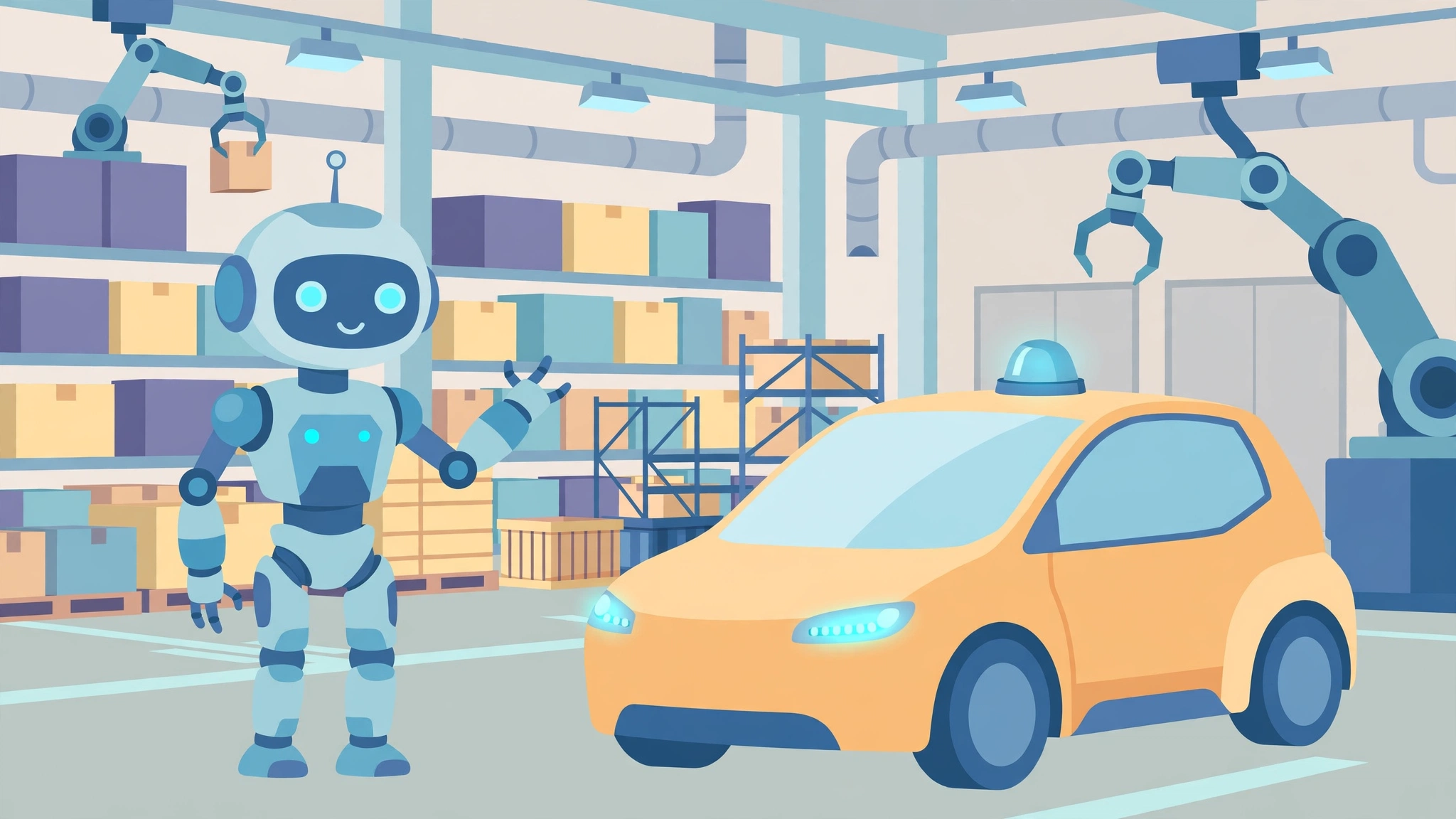
Physical AI is artificial intelligence that lives in the real world: it senses its surroundings, reasons about what to do, and then acts — through a robot, a car, a machine on a factory floor. If generative AI is a brain in a chat window, physical AI is that brain given eyes, hands and wheels. It is the AI inside warehouse robots that pick your parcels, self-driving cars that read the road, and humanoid robots learning to fold laundry.
The term is new, but the idea is the next step in a sequence you already know. First came perception AI — systems that could see and hear, like face unlock and voice assistants. Then came generative AI — systems that could write, draw and code, like ChatGPT and Gemini. Physical AI is the third wave: systems that understand the laws of physics well enough to move through the world without breaking things. This guide explains what is physical ai in plain English, how it differs from embodied AI, where you already meet it, how it is trained, and what it still cannot do.
Table of Contents
Key Takeaways
- What is physical ai? AI that perceives, reasons and acts in the real world — robots, self-driving cars, delivery robots and smart factories, not chat windows.
- NVIDIA defines it as AI that “understands instructions and perceives, interacts and performs complex actions in the real world to power autonomous machines like robots and self-driving cars.”
- The term was popularised from 2024 by NVIDIA CEO Jensen Huang, who called it the next wave of AI at Computex in June 2024 and “the era of physical AI” at CES in January 2025.
- Embodied AI is the older academic idea (from the 1980s) that intelligence needs a body. Physical AI is the newer industry umbrella — embodied AI is a subset of it, not a synonym.
- Physical AI is trained mostly in simulation: robots practise millions of times inside digital twins of the real world before they ever touch a real object.
- It is still narrow. A robot that works in one warehouse or one home often fails in another, and safety, jobs and regulation questions are wide open.
Physical AI vs Generative AI: The Third Wave
To see what is physical ai, it helps to see the two waves before it. Perception AI learned to interpret the world: recognise a face, transcribe speech, spot a tumour on a scan. It could see, but it could not do anything with what it saw. Generative AI learned to create: write an essay, draw a picture, write code. It could produce, but only inside a screen — it had no body and no sense of the physical world at all.
Physical AI closes that gap. A language model does not know what a cup weighs, how slippery a wet floor is, or how much force breaks an egg. A physical AI system has to know all three, because it acts on the world and the world pushes back. The loop is always the same four steps: perceive (cameras, lidar, touch sensors), reason and plan (world models that predict what happens next), act (motors, grippers, wheels), and learn (from simulation and from real feedback). A chatbot’s mistake costs a wrong sentence. A robot’s mistake costs a broken glass — or worse — which is why physical AI is trained so differently from the chatbots you know.
| Wave | What it does | Where it lives | Example |
|---|---|---|---|
| Perception AI | Sees and hears | Sensors and screens | Face unlock, voice assistants |
| Generative AI | Creates text, images, code | Chat windows and apps | ChatGPT, Gemini, image generators |
| Physical AI | Perceives, reasons and acts | Robots, vehicles, factories | Warehouse robots, self-driving cars, humanoids |
What Is Physical AI vs Embodied AI?
Search for what is physical ai and you will immediately meet a second term: embodied AI. The two are often used as synonyms, including by NVIDIA itself — but they are not the same thing, and the difference matters if you want to understand what is physical ai rather than just repeat the phrase.
Embodied AI is the older, academic idea. It is a research tradition dating to the 1980s, rooted in the claim that intelligence cannot exist separately from a body and an environment: an AI system cannot truly understand the physical world by reading about it; it must interact with the world through sensors and actuators and experience the consequences of its actions. The landmark paper is Rodney Brooks’s 1991 “Intelligence Without Representation”, which argued that intelligent behaviour could arise directly from a machine’s simple physical interactions with its environment.
Physical AI is the newer, industry term. It was popularised from 2024 onward, primarily by NVIDIA, to describe the commercial application of AI to physical-world systems. The cleanest way to hold the distinction: embodied AI is a claim about how intelligence works (it needs a body); physical AI is a category that draws a boundary around a class of systems (machines that act in the physical world). Embodied AI is a subset of physical AI — a predictive-maintenance system watching a turbine counts as physical AI with no body in any ordinary sense, while a humanoid robot learning by touching objects is both.
The term itself has one more root worth knowing. In 2020, researchers Aslan Miriyev and Mirko Kovač used “physical artificial intelligence” in Nature Machine Intelligence for something specific: robots whose intelligence lives partly in their materials and shape — a soft polymer that changes form in response to heat performing a kind of computation in the body itself. That academic usage faded; the industry usage, launched by Huang at Computex in June 2024 and escalated at CES in January 2025, is the one the world now means.
Where You Already Meet Physical AI
If you are still wondering what is physical ai in practice, look at where it already works. It sounds futuristic, but you have probably already met it — just not in the humanoid-robot form the headlines show. Here is where it actually works today.
Warehouses and logistics. This is the most mature application. Robots from companies like Amazon and Boston Dynamics move shelves, pick parcels and sort packages in warehouses, guided by cameras and sensors rather than fixed tracks. It is the largest real deployment of physical AI in 2027, and the reason one analyst estimate put the physical AI sector at roughly $81 billion in 2025 — treat that figure as an analyst estimate, not an established fact, but the direction of travel is clear.
Self-driving cars. A self-driving car is a physical AI system on wheels: it perceives the road with cameras, lidar and radar, predicts what pedestrians and other cars will do, and acts by steering, braking and accelerating. It is also the hardest test case, because the real world is messier than any warehouse — which is why full self-driving is still geofenced to mapped areas rather than everywhere.
Delivery robots and drones. Pavement delivery robots and warehouse-to-door drones navigate real streets and weather. They are small, slow and heavily supervised, but they run the same perceive–reason–act loop as their bigger cousins.
Smart factories. Robotic arms that adapt to parts that arrive slightly out of place, quality-inspection cameras that spot defects a human eye would miss, and predictive-maintenance systems that hear a bearing failing before it breaks. Much of this is physical AI without a body in the robot sense — the system acts on the physical world through machines it controls.
Humanoid robots. The headline application, and the least mature. Humanoids from Tesla (Optimus), Figure and others are learning to walk, grasp and carry in controlled settings, and NVIDIA’s Isaac GR00T platform gives developers an open reference stack for building them. They are real, they are improving fast, and they are not yet doing useful work in ordinary homes — which brings us to the honest limits. Google DeepMind’s Gemini Robotics is the other major platform in this space.
How Is Physical AI Trained? Simulation and Digital Twins
You cannot train a robot the way you train a chatbot. A chatbot can read the whole internet; a robot cannot break a million real glasses learning to pick one up. That is the first practical clue to what is physical ai: it has to learn physics, not just language. So physical AI is trained mostly in simulation — inside a digital twin, a virtual copy of the real world where physics is simulated and a robot can practise a task millions of times, fail safely, and learn from every failure.
NVIDIA’s three-computer solution, described on the NVIDIA blog, is the clearest picture of how the industry does it. First, DGX AI supercomputers train the models on huge amounts of data. Second, Omniverse and Cosmos run on RTX PRO servers to simulate — Cosmos is NVIDIA’s world-model platform, which generates realistic physical scenarios for the robot to practise in. Third, Jetson AGX Thor, a computer that sits on the robot itself, runs the trained model in real time so the robot can act without waiting on the cloud.
The hard part is the transfer: a skill learned in simulation has to survive contact with the real world, where friction, weight and lighting are never exactly as modelled. Engineers call this the sim-to-real gap, and closing it — by randomising the simulation so the robot learns the range of reality, not one perfect copy of it — is where most of the research effort goes. A robot that folds laundry in a simulator folds laundry. A robot that folds laundry in your home has to deal with your lighting, your floor and your particular crumpled shirt.
If you want the background on the intelligence inside these machines, our what is a neural network guide explains how the models learn, and our different types of AI guide places physical AI among the other kinds — narrow AI, generative AI, agentic AI and the rest.
What Physical AI Cannot Do Yet
The honest version of what is physical ai includes its limits, and they are large. Knowing them is the difference between understanding the field and repeating a press release.
- It is narrow. A robot that works in one warehouse or one home often fails in another. General-purpose ability — the thing humans do without thinking — is still the hardest problem in the field.
- It is brittle. Change the lighting, move a chair, hand it an object it has never seen, and performance can collapse. Robustness to the unexpected is the research frontier, not a solved problem.
- It is expensive. The sensors, the compute and the simulation time cost real money, which is why the first deployments are in warehouses and factories where the economics work — not in homes.
- It raises safety questions no one has fully answered. A robot that shares space with people needs to fail safely, every time. Standards are being written now — the first international standard for the field, ITU-T F.748.66, was ratified in December 2025 — but regulation is still catching up with the technology.
- The jobs question is real. Warehouse and factory work is where physical AI lands first, and those are real jobs held by real people. Our what jobs are safe from AI guide looks at which work is exposed and which is not — the honest answer is that physical work is now exposed in a way it was not five years ago, and the adjustment will be measured in years, not months.
What Is the Future of Physical AI?
At NVIDIA’s GTC conference in March 2026, Jensen Huang called this the “ChatGPT moment for robotics” — the point where the models, the simulation and the hardware are all good enough at once for the field to accelerate. Whether that turns out to be true or just a good line will be decided by deployment, not by demos: by whether humanoid robots start doing useful, paid work outside controlled settings, and whether self-driving expands beyond mapped zones.
The most likely near future is boring in the best way: more warehouses, more factories, more logistics — the places where the economics already work and the environment is controlled. That is the real test of what is physical ai: not the demo, but the deployment. The home is the last frontier, not the first, because homes are the least controlled environment there is. And the skill that matters for people watching this field is not robotics trivia — it is judgement about where a physical system genuinely helps and where a person still does it better. If you are in education, our AI in education guide covers how schools are already adapting to AI that acts, not just AI that writes.
Frequently Asked Questions
Is physical AI the same as robotics?
Not quite. Robotics is the whole field of building machines that move — including remote-controlled and pre-programmed machines with no AI at all. Physical AI is the intelligence inside the machine: the part that perceives, reasons, plans and learns. A traditional factory arm following a fixed program is robotics without physical AI; a warehouse robot that adapts to a parcel in an unexpected place is both.
What are examples of physical AI?
Warehouse picking robots, self-driving cars, delivery robots, drone delivery, smart-factory arms, surgical-assist robots and humanoid robots. The common thread is always the same: the system senses the physical world and acts on it.
What is NVIDIA’s role in physical AI?
NVIDIA popularised the term and supplies much of the stack: DGX supercomputers for training, the Omniverse and Cosmos platforms for simulation, Jetson computers for on-robot inference, and the Isaac GR00T reference platform for humanoid robots. Its glossary defines physical AI as AI that lets autonomous systems “perceive, understand, reason, and perform or orchestrate complex actions in the physical world” — see the NVIDIA physical AI glossary for the full definition.
Will physical AI replace human workers?
It will replace some tasks before it replaces whole jobs, and warehouse and factory work is first in line. The honest answer is that nobody knows the pace — it depends on deployment economics and regulation as much as on the technology. What is certain is that physical work is now exposed to automation in a way it was not five years ago.
How is physical AI different from agentic AI?
Agentic AI operates in digital environments — it books, writes, codes and plans inside software. Physical AI operates in the physical world. As NVIDIA puts it, agentic AI works in digital environments while physical AI models can perceive, reason, interact with and navigate the physical world. Many real systems will combine both: a digital agent that plans the delivery and a physical system that drives it.
Can I learn physical AI?
Yes, and the entry point is ordinary: robotics, computer vision and machine learning, in that order. Simulation tools like NVIDIA Isaac Sim are free to explore, and a grounding in how neural networks learn — plus a willingness to work with hardware — matters more than any single course. Start with simulation; real robots come later, and they are expensive to break.
At Digital Discoverist, we test AI tools against the job they are actually for — and the job of physical AI is not to impress you in a demo video, it is to do useful work in a messy world without breaking anything. The wave is real, the deployments are growing, and the honest limits are still large. That is exactly what makes the question of what is physical ai worth asking in 2027. You will find more tools and ideas judged the same way in our Tech Insights collection and in our best AI tools roundup.
3 thoughts on “What Is Physical AI in 2027? Robots, Self-Driving Cars and the Next Wave of AI”