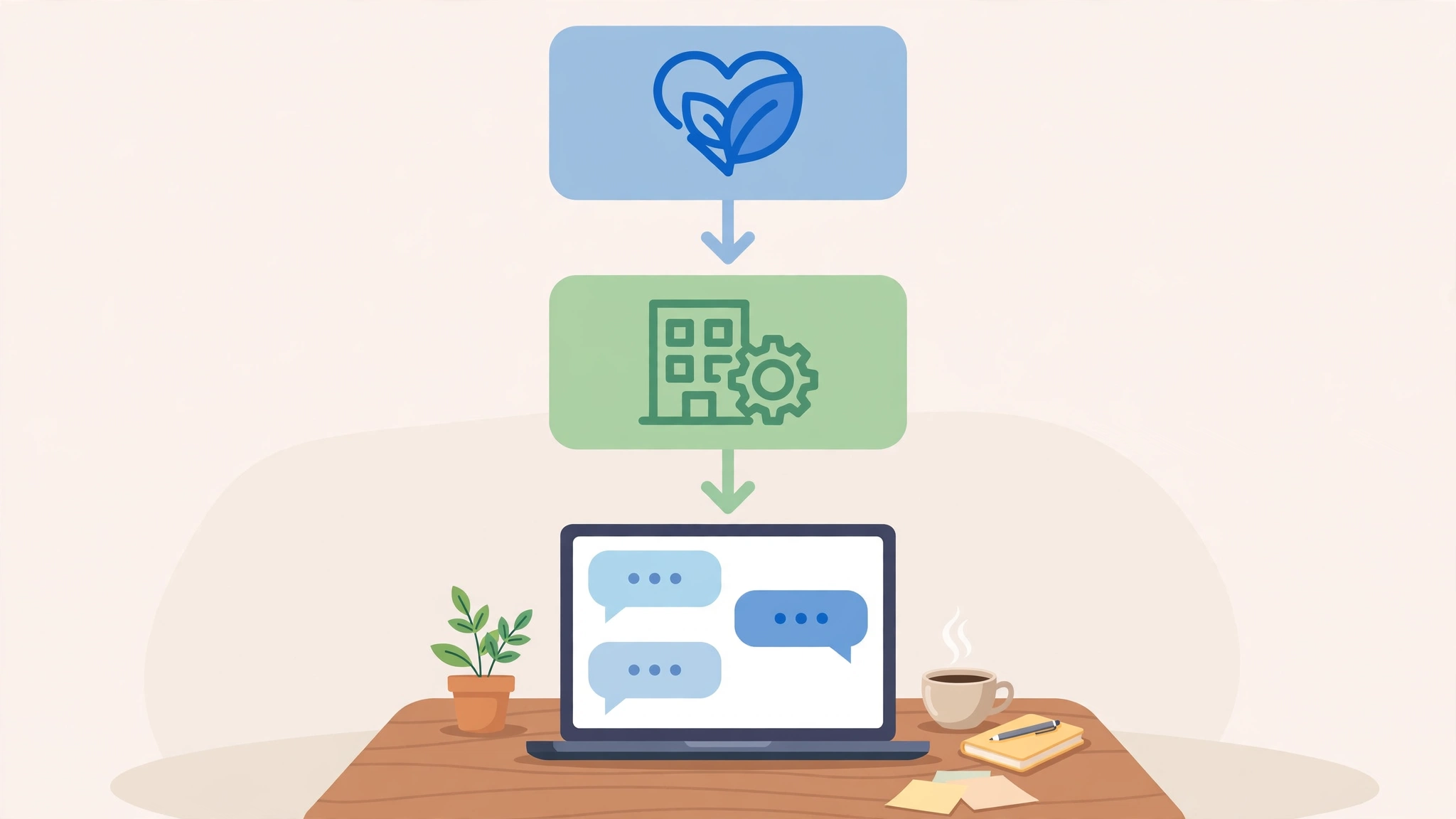
Who owns chatgpt? The short answer is OpenAI. The longer answer — the one that explains why ChatGPT keeps changing its rules, its pricing and its data policies — is that no single person or company owns it outright. ChatGPT is a product of OpenAI Group PBC, a public benefit corporation, which is controlled by a nonprofit called the OpenAI Foundation. Microsoft is a major shareholder, but it does not own or control ChatGPT. Elon Musk helped found OpenAI but left in 2018 and does not own it. This guide explains that structure plainly: who owns what, who controls what, and why the two are different.
Key takeaways
- ChatGPT is owned and operated by OpenAI — specifically OpenAI Group PBC, its commercial arm.
- Control sits with the nonprofit OpenAI Foundation, which governs the company even though it is not the largest shareholder.
- Microsoft is the largest commercial shareholder (about 27% as reported at the October 2025 recapitalisation) — a major investor and partner, not the owner.
- Elon Musk co-founded OpenAI and left its board in 2018; he does not own ChatGPT and holds no role in the company.
- Sam Altman is OpenAI’s CEO and public face, but he does not personally own ChatGPT — running a company is not the same as owning its product.
Direct answer: In 2027, ChatGPT belongs to OpenAI Group PBC. The OpenAI Foundation, a nonprofit, holds governance control over that company. Microsoft, SoftBank, Nvidia, venture firms and employees hold economic stakes, but none of them individually owns ChatGPT. If you remember one sentence, make it this: OpenAI owns ChatGPT, the Foundation controls OpenAI, and Microsoft invests in OpenAI.
Table of Contents
Who owns ChatGPT?
ChatGPT is a product, not a company, so “who owns ChatGPT” really means “who owns the company that builds and runs it”. That company is OpenAI Group PBC. OpenAI builds the models behind ChatGPT, runs the service, owns the brand, and employs the teams that develop it. ChatGPT itself has no separate owner, no separate shareholders, and no independent board — it lives inside OpenAI’s corporate structure. That is why questions about ChatGPT’s ownership quickly become questions about OpenAI’s ownership, and why the answer involves a nonprofit, a public benefit corporation, and a list of investors rather than a single name. For the technology behind the product, see our explainer on what a neural network is and our questions about AI, answered simply.
Who created ChatGPT?
ChatGPT was created by OpenAI and released publicly on 30 November 2022. OpenAI itself was founded in December 2015 as a nonprofit research organisation, with the stated goal of developing artificial intelligence for the benefit of humanity. Its early founders included Sam Altman, Elon Musk, Greg Brockman and others from technology, research and investment. Founding an organisation, however, does not confer permanent ownership of its later products: Musk left OpenAI’s board in February 2018,
and his historical association does not make him ChatGPT’s owner. Altman became the company’s central figure and remains its CEO, but the product belongs to the company, not to any founder
personally.
The OpenAI structure, explained simply
OpenAI’s structure is unusual, and it is the key to the whole question. Think of it in three layers. At the top sits the OpenAI Foundation, a nonprofit. It does not run ChatGPT day to day, but it governs the company below it and holds the ultimate authority over major decisions — famously demonstrated in November 2023, when the nonprofit board fired and then rehired Sam Altman within five days. Below the Foundation sits OpenAI Group PBC, a public benefit corporation: this is the commercial company that sells subscriptions, employs staff, takes investment and operates ChatGPT. A public benefit corporation is a for-profit company whose charter also requires it to balance shareholder returns against a stated public benefit mission — a legal obligation ordinary corporations do not carry. Below that, in effect, sit the products: ChatGPT, the API, and enterprise tools, all run by OpenAI Group PBC. Ownership (who holds shares) and control (who can overrule decisions) are therefore split by design: shareholders hold economic stakes, while the Foundation holds governance control.
What happened in October 2025?
On 28 October 2025, OpenAI completed a recapitalisation that replaced its earlier capped-profit structure with a conventional equity model. The for-profit arm became OpenAI Group PBC, a Delaware public benefit corporation, and all equity holders received conventional stock that grows proportionally with the company’s value, with no profit caps. The OpenAI Foundation retained governance control through special voting rights, even though its equity stake was reported at about 26% — valued at roughly $130 billion on the transaction’s disclosed basis. Microsoft’s stake was reported at roughly 27%, valued at about $135 billion on the same basis, with current and former employees and other investors holding the remainder. Those figures are a snapshot from October 2025, not a permanent fact: later financing rounds, employee transactions and dilution can change the distribution, so check OpenAI’s own structure pages for the latest position rather than quoting a 2025 snapshot as today’s exact split.
Who are OpenAI’s shareholders?
| Shareholder / group | Role | What it does NOT mean |
|---|---|---|
| OpenAI Foundation (nonprofit) | Governs OpenAI Group PBC; ~26% equity at Oct 2025 recapitalisation | It is not a commercial owner chasing profit |
| Microsoft | Largest commercial shareholder, ~27% at Oct 2025; cloud and product partner | Microsoft does not own or control ChatGPT |
| SoftBank, Nvidia, venture firms | Major investors (including Thrive, Sequoia, Andreessen Horowitz and others) | Investment alone does not equal control |
| Current and former employees | Significant collective equity stake | Employees do not individually own ChatGPT |
| Sam Altman (CEO) | Runs OpenAI; widely reported to hold no OpenAI equity | Being CEO is not owning the product |
| Elon Musk | Co-founder, left the board in 2018 | No ownership, no role, no control today |
Microsoft’s role deserves a closer look, because it causes the most confusion. Microsoft has invested heavily in OpenAI, provides cloud infrastructure through Azure, and licenses OpenAI technology across Windows, GitHub, Office, Copilot and its enterprise tools. That partnership is close and commercially important. It is not ownership: Microsoft does not sit above the OpenAI Foundation, it does not appoint the Foundation’s board, and ChatGPT is not a Microsoft product. Saying “Microsoft owns ChatGPT” is like saying a bank that holds a large stake in a company owns that company’s products — it confuses investment with control.
Does Elon Musk own ChatGPT?
No. Musk helped create OpenAI and supplied early funding, then left its board in 2018. He later sued OpenAI, arguing that its shift away from its original nonprofit mission betrayed its founding charter; OpenAI disputed those claims. Whatever the outcome of that dispute, Musk holds no ownership or control over ChatGPT today, and he runs a separate AI company of his own. The persistence of the “Musk owns ChatGPT” myth shows why this question keeps being asked: the founders are famous, the structure is unusual, and a simple wrong answer travels faster than a correct complicated one. The same logic applies to Altman: he is the public face of OpenAI and drives its research and product direction, but he does not personally own ChatGPT, and reports have consistently described him as holding no OpenAI equity — an unusual arrangement for a tech CEO, and one more reason the structure confuses people.
Why does this ownership structure matter to users?
It matters for three practical reasons. First, it explains why ChatGPT’s policies can change suddenly: the Foundation’s governance role means decisions are not driven purely by shareholder returns, while commercial pressures from investors pull in the other direction — and users feel that tension as changing limits, features and prices. Second, it affects trust: a nonprofit-controlled company promises a mission beyond profit, but it is still a commercial company that sells subscriptions and takes investment, so its promises should be judged by its actions, not its structure alone. Third, it affects the product’s future: a change in control, a major financing round, or a regulatory decision could reshape ChatGPT more than any model update. Users do not need to follow every filing, but they should know that ChatGPT’s owner is a company with a split between ownership and control — because that split is the reason simple answers to “who owns ChatGPT” are always wrong. For OpenAI’s product comparisons, see our ChatGPT Pro vs Plus guide and our best AI tools guide. For sourced background, see the CEO World breakdown of OpenAI ownership explained and LegalClarity’s who owns ChatGPT analysis.
Frequently asked questions
Who is the owner of ChatGPT?
OpenAI Group PBC owns and operates ChatGPT. The nonprofit OpenAI Foundation governs OpenAI Group PBC. No single person owns ChatGPT outright.
Does Microsoft own ChatGPT?
No. Microsoft is OpenAI’s largest commercial shareholder and a major partner, but ChatGPT is not a Microsoft-owned product, and Microsoft does not control OpenAI.
Is ChatGPT owned by Google?
No. Google’s assistant is Gemini, a separate product from a separate company. ChatGPT belongs to OpenAI, not Google.
Is OpenAI a nonprofit?
OpenAI began as a nonprofit in 2015. Today it is a hybrid: the nonprofit OpenAI Foundation governs a commercial public benefit corporation, OpenAI Group PBC, which runs ChatGPT. Saying “OpenAI is a nonprofit” without that second half is incomplete.
3 thoughts on “Who Owns ChatGPT in 2027? OpenAI, Microsoft and the Nonprofit Explained”